
S4E410 - Transcript
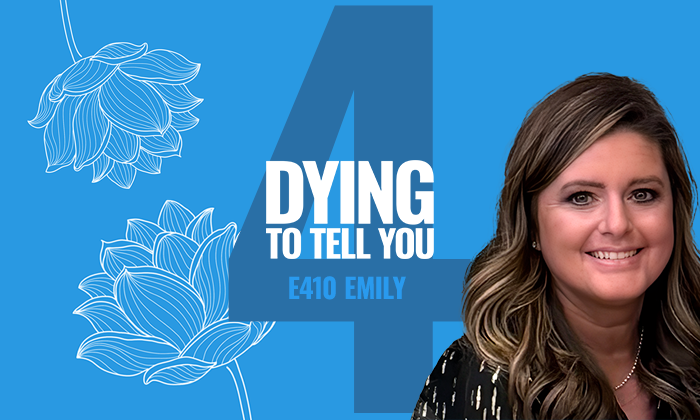
Listen and subscribe on Spotify or Apple Podcasts.
S4E410 — I’ve Lived a Good Life
Emily [00:12] I have found rest, and this is the path that God has put me on. I kind of just let that be my focus. This earthly life isn't the end, and how I live my life here, I want to live it for the eternal life I'm moving toward.
Cody [00:38] We all age. Some of us more gracefully than others, but we all age. We develop wrinkles on our face, our hair and our beards turn gray. Our bodies change. New aches and pains show up. We don't recover as quickly as we used to. We can't run as fast as we once could. We get tired a little faster than we used to. All of this is expected. It's the price we pay for the privilege of getting older.
Cody [01:05] Emily was having this experience in 2021. She had a smattering of things happening with her body. Some of them were inconvenient or annoying, but as she says, there were no flashing lights to indicate that something bigger was happening. She had Raynaud's, a narrowing of the blood vessels in her fingers and toes that reduces blood flow. On its own, that's not a red flag. She had some GI issues, which she attributed to a lasting symptom that had come on with pregnancy.
Cody [01:34] She was very tired, which she attributed to having two kids, working, and getting older. She had gained some weight, also something expected as one ages. She had lost the ability to do some of the tumbling she had done as a cheerleader in high school and college. Again, nothing out of the ordinary for someone aging and not practicing regularly. Then one day she was listening to her mother describe the symptoms Emily's uncle was having, and she started checking off boxes in her mind.
Cody [02:04] Emily's uncle had been diagnosed with scleroderma. Emily began trying to connect the symptoms. She saw her doctor and got a referral to a rheumatologist. The first rheumatologist believed she might have scleroderma as well, but wasn't familiar with treating it. So Emily went across the state, from Memphis to Nashville, to see her uncle's doctor at Vanderbilt. There she was diagnosed with diffuse scleroderma, and her new life began to take shape.
Cody [02:36] This is Dying to Tell You.
Emily [02:41] It's a little shocking, especially if you're like me, or probably anyone, and you get online and start looking it up. If you look it up, it'll say your life expectancy is 10 to 15 years. That's what it says. I even said that to her. I was maybe 38 or 39 at that point when I saw her. I'm 41 now. And I said, I don't want this to be where I'm at. We've got to do something. I'm a fighter. I'll do whatever you want me to do. She has a wonderful bedside manner, and she said, yes, that used to be the life expectancy, but we have so many tools now that can put the disease into remission. It basically stops your body from fighting itself. As long as we keep trying different things, you're going to live a fine life, a pretty normal life expectancy, especially since we caught it as early as we did.
Emily [03:57] I went from shock to a little bit of sadness and depression, realizing I'm not normal anymore. That's hard for someone like me, a busybody. I just want to go, go, go. Then I got a little mad. Why me? Why do I have to endure this? And then I settled in: this is life, these are the cards I've been given. Now we can choose to pout and lie in bed and be miserable, or we can fight and keep going. Then I thought about a woman I know who also has the disease, and she has had many more difficulties from it than I do. She was a great inspiration to me, because I could see she could still function and live life full. If she can, so can I. I can probably live it more easily. I shouldn't be complaining or upset. I've just got to put on my big girl panties and go.
Cody [05:03] Yeah. I mean, you're so right. First of all, not being normal anymore is a real reaction, for sure. And nobody's normal. Everybody's got something going on. Normal's not even a real thing. But the thing you said about these being the cards you've been dealt, what am I going to do with them? I would be shocked if you didn't every now and then lie in bed and pout about it. The anger, the sadness, and I would imagine the worry as you think down the road about how it will progress. You do have that choice. You can sit and pout and pack it in, or you can live your life the way you want to live it. That's the way it is with most things that happen to people, unless you get hit by a bus. Somebody has heart disease, and they adjust and keep living their life. You get cancer, you adjust and keep living your life. You can just pack it in. I have seen people do that, incapable of getting to a place of acceptance and a desire to live with the thing they have. That's hard, and then the diagnosis becomes their whole personality, their whole life. That's a choice, and some people do it that way. But it sounds like that's not your choice.
Emily [07:24] No. I have too much to live for. It is what it is. I can't change it. And like you said, I have to remind myself regularly that this is the cross I'm going to bear in this earthly life. But other people also have issues they fight every day. Theirs just look different from mine, and that's okay. I've chosen to take the path of helping someone else who is living the same thing. And what a beautiful thing social media is. You couldn't find people before, especially with scleroderma, who are in the same boat as you. What a wonderful outlet to see that others are crossing the same bridges, and theirs may be like yours or may be different, but I'm not alone. There are people out there living the same way I am.
Cody [08:20] Yeah. How is it affecting your life? I've already said normal isn't a thing, but your normal was a thing. Let me ask it this way. You were living your life and having all these symptoms of scleroderma that you didn't realize were symptoms of scleroderma. How has that changed since your diagnosis?
Emily [08:52] Sure. Well, it went into a bit of a hole. It was bad before it got better. The struggle with this disease is that I was really good for a while, and then even from the last time I talked to you, I went down. I started school again. I'm a teacher. I was on Rituxan infusions, and they had me pretty chilled out, had my body where it needed to be. My numbers were good. Then, all of a sudden, every time I go back to school, it gets a little rough. My body gets unhappy. I have a lot of inflammation, but I usually settle, and it's about three weeks. This time it went a little deeper. I call them flares. I was having horrible GI issues, throwing up, just awful, exhausted. I called my doctor and said I don't know what to do. So I went and saw her this week.
Emily [09:51] Stress is a huge driver for scleroderma, and that's not good. But I also don't want to not work. I want to work as long as I can, and I have the ability to. That's been a struggle. My normal of going ninety to nothing all the time has had to slow down. There are days I just have to lie in bed, and I hate that. I don't want to do that. I think part of it is that I don't like to appear lazy. I'm a mom. I don't want my kids to remember their childhood as the time their mom needed to lie in bed. That's my own stupidity at times, you know? That's hard for me. But there are days I have to stop and be still, especially after really busy days. This school year I've already had to take a day off. When my body starts acting up, I realize I've got to stop and take a day. I do nothing that day. I lie in bed. Some days I don't even watch TV. I just lie there in the silence. That's frustrating. That used to never be my normal. I would never sit, especially not get back in bed. That's not happening, but it is a reality.
Emily [11:19] I've had to realize that in the past I've had to go get infusions. I've got to go to Nashville, spend two days, knock it out, and come back. Doctor's appointments, that's my reality, and that stinks. I don't want to do it. I miss things with my kids. I miss ball games. That's hard, and I feel guilt about it. But other than that, my day-to-day life is pretty normal now. I went through a time when my inflammation was so bad that I was wrapped. I was going to a physical therapist at six in the morning, and she was wrapping my legs in ACE bandages to try to get the fluid out. I would lie in those for twenty-four hours. I'm past that, and I don't have to do that anymore. But she's changed my medication, and I'm about to start a new one. I think that's the thing that needs to be said when you live with a chronic illness: one medication may not last the whole time. It's constant trial and error, and that's hard.
Cody [12:32] So it becomes less effective, or ineffective. You're on a treatment, and then it becomes less effective.
Emily [12:41] Well, when I saw her this week, she said, okay, and she's always like, we can do better. What is driving this? She said, Emily, it could be stress, and that could be why we're seeing a change. So we decided, okay, we're going to stop the Rituxan infusions and try Actemra, which is a shot you give yourself once a week. It's also a biologic. We're going to give it six months, and if we don't like what we see, we can always go back to Rituxan infusions. Rituxan is a medication you can't always take, because your body has to meet certain criteria. Actemra is used a lot for patients with more lung involvement. I don't have lung involvement at the moment, so it wouldn't have been her first choice for me. I had a lot of skin involvement, and Rituxan is great for skin. So now we risk what happens to the skin. But you never know till you try. I wouldn't say the Rituxan isn't working, because when we got my blood work back, it looks beautiful. It's perfect. That tells us the symptoms I'm seeing are probably stress-induced.
Cody [14:11] I can imagine it's frustrating, this trial-and-error thing. You're on this, something happens, and you try a different drug. We're going to give it six months and see how it goes, and if it's good, you'll stay on it, I guess. If something else pops up, something else pops up. It feels a little like you're not a guinea pig, because it's not like that, but it's trial and error, and you're plugging holes in a dam. You plug one, and another hole pops open. Like whack-a-mole. That's frustrating.
Emily [14:57] Yeah, it's annoying, because you think you've been on Rituxan infusions for two years, and it's been beautiful. I say Rituxan saved my life. It changed the whole trajectory. And I'm annoyed. Pissed would be the best word. I don't want to change. I don't want to do something different. But in the back of my mind I'm thinking, what if this change is for the good? Maybe it's fantastic. And if it's not, we just go back to where we were, and that's okay too. I do love that I'm not going to have to miss out on [unclear]. With Rituxan, I live in Memphis, and Nashville is a three-hour drive. I'd try to do my infusions early in the morning, so I'd have to go the night before and spend the night. Then the infusion takes five to six hours, and then I come home. The day after, it takes me a while to catch back up. I'm not going to have to do that anymore. I'm praying Actemra makes a smooth transition. I don't know how it's going to make me feel. It's a shot in the dark, and that's very frustrating. It is, but I have to make peace with this being life. I'm going to take it like a champ and move on.
[MUSIC]
Cody [17:13] Stories we share here on Dying to Tell You are true. That's what makes them so powerful. But true stories aren't the only way to explore life's mysteries. Sometimes it takes a story that's nearly true. That's why I'm excited to share a new podcast with you called Nearly True Stories, audio versions of short fiction, brought to you by the producer of Dying to Tell You, Chris Rock. You can find Nearly True Stories on Apple Podcasts and Spotify. If you're a writer yourself, submit your short fiction to the Nearly True Stories submissions address. That's Nearly True Stories on Apple Podcasts and Spotify. And now, back to the true stories.
Cody [18:01] I don't know that many people know much about scleroderma. We've had a couple of people with scleroderma on the podcast, but you have skin and GI involvement. I don't know that people understand what scleroderma does when there's GI involvement. I've had patients in the hospital who had GI involvement, and it's been pretty awful. I guess you probably already know that, but would you talk a little about what scleroderma does to the GI tract that makes it so difficult?
Emily [18:47] Sure. Scleroderma in general hardens everything. It hardens you from the inside out. I have horrific acid reflux, GERD, and I deal with that on a regular basis. We have it tamed with an oral medication. It helps. Some days one pill does it, like yesterday, when one wasn't going to cut it, so I took another. That's the beautiful thing about it. I can take that, and it pretty much stays tamed. This is going to sound gross, but you constantly feel like you're going to poop your pants. I do all the research for my doctor, and one of the questions on the list is whether you feel timid about going places or doing things because you're terrified you'll have an accident. Absolutely. That's a day-to-day thing. It's a gross thing, and especially as a female, you hate to think about it, but it is what it is. I throw up and have diarrhea regularly. That's just a normal day-to-day thing. I may go a while without throwing up, but the whole exodus side of it is awful. When it hits, you're running. There are times I'm out in public and I think, my gosh, I hope that didn't come out. I've even looked at my nine-year-old daughter and asked, do I have anything on my pants? How awful is that? But you have to take the side that you just take, and you just have to laugh at it. It's gross, but it is part of the disease I deal with daily.
Cody [20:49] Yeah. My understanding is that because scleroderma is hardening everything, it makes it harder for food and nutrients to absorb into your body. Your GI tract is constantly moving things through, and when it hardens up, it's harder for things to move through. So the throwing up, I think, doesn't...
Emily [21:21] Pushback is normal. That's why I have a GI doctor and have endoscopies all the time. A lot of scleroderma patients have a delay in stomach emptying. I've had that test, and that's not me at this moment. Mine is functioning okay, normal. But it's almost like you said: you're not absorbing it, and it just comes through. It doesn't tend to matter what I eat. You'd think highly acidic food wouldn't be good, and yes, it's not great, but I could eat bread and it would give me horrific heartburn, or it would go straight through me. My friend cannot eat Chick-fil-A without ending up in a bad spot. That's just not going to be good. My doctor has mentioned going gluten and dairy free to see whether that helps. I've had all of these allergy-type tests done to make sure nothing is interfering, and it's not. It's just an annoying side of scleroderma I have to deal with. I tend to have lots of GI issues.
Cody [22:37] Yeah. I think a lot of people don't know what scleroderma is to begin with, and they don't realize that the GI piece is part of it too. It can affect people's lungs and heart. All tissue, right?
Emily [22:56] Yes, all tissue. That's one of the things. I also have myositis, which is an overlap with scleroderma that affects the muscles. I have regular PFTs, pulmonary function tests, where they check the lungs and compare them to my baseline from when I started. I've had a little decline in the lungs, but my doctor tells me I'm still an A. That's good. We want to remain an A. I have that test all the time. My heart is checked once a year. Those are all major organ involvements that can be affected. Whatever test she ran, and I'm not totally sure which one, she told me very early on that one of my main organ involvements would probably be my kidneys. She's constantly watching for renal crisis.
Cody [23:51] I'm wondering whether you've had discussions with her about likely progression. Does she think the way you're treating it will stem the progression? What have y'all talked about?
Emily [24:14] She hasn't gone too deeply into what we're going to do when that comes. She wants to watch regularly, because if we have a good baseline, we know where we're going and we can tell when we get a drop. But we haven't talked much about what we're going to do when that hits. I trust her enough to feel she advocates for me. I also advocate for myself regularly. We've had some run-ins with infusions, because she does them a little differently than some patients' doctors do. I really had to advocate for myself. When they went back to her, she clarified that my patient was correct. She was right. So no, we haven't gone deep into what we're going to do when it hits. That's the waiting game. I could sit in the calm of this disease, but you never know when it's going to rear its head.
Cody [25:28] The waiting and the uncertainty of how and when this is going to rear its ugly head, a flare or progression, is something a lot of the people I talk to have in common, whether it's serious illness, chronic illness, or progressive illness. Somebody with stage four cancer who has no evidence of disease knows at some point it's going to come back. So it's just, when is it going to come back, and where? You're in much the same place. It will probably progress in some way, or you'll have a flare. When and where and how are all so uncertain. How is it for you to live with that in the back of your mind? How often does that thought come into your mind?
Emily [26:31] It's always there. I try not to focus on it. I try to focus on the positive. I think I've even told you this before. I find my rest in the fact that Jesus knows. He knows exactly what's going to happen and when it's going to happen. I could walk out tomorrow, get in my car, and have a car wreck, and it's over. Or I could sit and focus on, gosh, when is it going to hit? I have found rest in this being the path God has put me on, and I kind of let that be my focus. This earthly life isn't the end, and how I live my life here, I want to live for the eternal life I'm moving toward. If I can shed light and bring others to know Jesus, that's my focus, not the disease. The disease allows me to talk to others. I hope people can see that I find my joy in other things, and that the disease doesn't define me. I was put on this earth to live for him. That's my focus. I teach in a Christian school. I teach four- and five-year-olds, and they're my focus in the day. Then my family is my focus after that. I want them to know that through prayer is where I get my strength. I can't do it for myself, because if I sat and focused, my human nature is to focus on the what-ifs. The anxiety and worry take over, because we're all sinful creatures. But I find my rest in God. Anytime I feel the emotion of what's going to happen, like, am I going to make it until my kids get married? Am I going to make it to see grandbabies? That's where I go.
Cody [28:49] Do you think you will?
Emily [28:52] Yeah, because I'm a fighter.
[MUSIC]
Cody [29:35] You mentioned, at least in the beginning, having the anger and the sadness. I imagine it pops up from time to time even now, especially on your lazy days when you have to be in bed. And you ask why. Why is this? Why me? Why this? Whatever it is.
Cody [30:07] What do you make of that? Why?
Emily [30:11] Why do I think bad things happen to good people? That's the mindset. Not that I'm a good person, but why do things happen to people? You have to understand that I live believing in God, where others may not. I believe there's a higher power. I grew up in the Deep South, in the Bible Belt. My raising and my own beliefs are that we live in a broken, sinful world, and because of that, bad things can happen. They can happen to anyone. How can I word this?
Cody [31:00] Yeah. Not only can they happen, they do.
Emily [31:03] They do. Yes, absolutely. They happen, and you question why. Why is this? As a Christian, I'm like, God, why? Why me? I think that's human nature, our instinct. That's what we live with. We're sinners. But then I have to think that from how I believe, God knew exactly what was going to happen to me, even when I was still in my mother's womb. He knew the trajectory of my life. No one loves me more than God the Father. His love is an everlasting love. It's my job to question why all I want. I'm never going to get that answer. It's never going to be available. I just sit in the fact that we live in a broken, sinful world, going back to Adam and Eve and the tree. Even though I ask why, I have to rest in the fact that he still loves me no matter what. This is the life I was given, and my job is to bring others to knowing his light. So instead of sitting and asking why about the scleroderma diagnosis, I sit in the fact that it's going to allow me to reach and talk to people I might never have reached.
Emily [32:31] Through this diagnosis, I'm going to have that capability. My goal is that yes, I have this really crappy thing going on, but I can still show love and shine God's light even in the thick of it. I also want people to see the reality, that it's not all sunshine and roses. You can be a Christian and still be angry and frustrated. That's normal. That's okay.
Cody [33:01] I don't think you can be a person and not be...
Emily [33:06] Yes, no. I think sometimes the portrayal is that it's not the case, but it very much is the case. Even though we believe in a higher power, we're still humans on this earth, and that's an earthly feeling.
Cody [33:25] Bad things happen, and we have reactions to them. Of course we get to choose how we act and respond when bad things happen. But the reaction of being sad or the reaction of being angry is completely normal and valid. Jesus wept at the news that his friend had died. Jesus was sad. I want to put something out there and see what you think. There's a Catholic priest, who lives in California and works with a lot of former offenders and former gang members. One of the things he says that I've really appreciated, in my time working with people who have a lot of bad things happening to them, is this: I believe in a God that protects me from nothing but sustains me through everything.
Cody [34:19] That fits with what you're saying, and that's why I thought of it. Bad things happen, and they happen to everybody. In my experience, God doesn't spare anyone from the end of life. We all get there, some earlier than others. But the God he believes in sustains him and gives him the strength to make it through the bad things. I appreciate that. Does that square with you?
Emily [35:06] Yes. I totally agree with that. As long as we're on this earth, we're going to go through trials and tribulations, some harder than others. I do believe the Bible and God's word are here to help us sustain and get through those things. If you look in the Bible, it's not a pretty book. It's a beautiful book, but there are lots of trials and tribulations throughout it, and their lives weren't easy either. Jesus's life was perfect. He did no wrong. And his life was hard on this earth. The wild thing is that God sent him anyway, knowing everything he would go through. He sent him for me, to die on the cross for me. So if God can send his own son to do that, I surely can get through the battle of scleroderma. Surely.
Cody [36:03] I think sometimes people get the message that if they're good, or if they pray enough, God will spare them from some bad thing. Then when bad things happen, it upends their faith and their worldview. It's a beautiful space, but it's really difficult too, because you have to rethink your worldview and your faith. I don't like it when bad things happen to people. But I do like the way people grow through them, and the beautiful things that come out of difficult times. I've had so many people tell me, especially in the last couple of years doing this podcast, that the thing that happened to them probably made their life shorter, but made it better. They come to a place where they appreciate people and things in a new and different way. People's faith is deeper. There's a lot of good growth that comes through these difficult diagnoses.
Emily [37:44] Totally agree. You see things in a different light, or you're forced to. Take going to the grocery store. A lot of people don't like to do it, a lot of women don't like to do it. It's stressful. But for me, going in the grocery store can be hard. You're moving a lot, it gets you out of breath, and it's exhausting for someone like me. So now I pretty much always pick up my groceries. I put my order in and get it. But it's somewhat freeing to sometimes go in and wander, because what is so easy and so annoying for some people is, to me, I can do this today. I have enough energy to do it. So you do crazy things like that. You think, I'm glad I can do this today. Do you see things differently? You definitely do. I think you take moments and enjoy them a little deeper and are more appreciative, just because you never know, this could be the last one. It could be anybody's.
Cody [38:54] Right. For sure. It's right there in your face, and that's part of why we do the podcast to begin with. It's true for everybody. It could be the last time I made coffee this morning, whatever it might be. I'm sitting here thinking about your kids. I imagine before scleroderma you loved your kids very much. And I imagine that after scleroderma, each little moment is a little more precious now. The mortality of it is more front and center. Things are a little more precious. You just appreciate...
Emily [39:49] And you appreciate the moments where you can go and participate with them, because you never know when that participation...
Cody [39:55] May not be available to you.
Emily [39:57] Yes. Or it's harder to get around. People think I'm crazy, because we live in Memphis and I take my children to University of Tennessee football games regularly. That's about a six-hour drive from one end of the state to the other. Does it wear me out? Absolutely. But it's an activity they enjoy, and my parents often go too. It gives me memories with them and with my kids. Do I face some toughness afterward, in my body? Yes. But why would I not? They're nine and twelve. They love it, and it gives me an enjoyable time with them, and I don't know how much longer I'm going to be able to do it. So I try to do things I would have said, no, I'm not doing that, to now saying, yes, okay, you want to go? Great, let's go. So my viewpoint and outlook on life have changed, especially at thirty-eight years old.
Cody [41:03] Yeah, for sure.
Emily [41:05] To me, that's young. I'm forty-one now, and even now, you think of things differently than a normal forty-one-year-old would.
Cody [41:14] Yeah, yeah.
Emily [41:15] Work is another thing. A lot of scleroderma patients end up on disability because they can't function. A lot of them have retracted hands and things like that. I don't have that yet. They can't work, and they want to, but they can't. So I try to enjoy my work as much as I can. Some days I want to pull my hair out, because I'm with little kids all day. But there's also joy in that, because they're so innocent and so full of life. That's very refreshing to me. I enjoy my job. I don't want to not work, so I love that. That's another thing I wish people would see: being able to work is a blessing, and it's not given to everyone. Not everyone can do it. So sometimes if you're complaining about something, you should be so thankful that your body can do it. Those are some of the things I enjoy, and I hope I can do them for a little bit longer.
Cody [42:19] Yeah. Yeah.
Emily [42:21] I would like to be able to do it until my kids graduate. I've got a sixth grader and a fourth grader. I've got a long way to go.
Cody [42:32] Yeah, that's a long time.
Emily [42:33] That's my goal. I would like to see them through. We're all on the same campus, so I love that. I like being able to pop in and see the activities they're doing. So I'd like to do it for a little bit longer. And even if I have to come out of the classroom, I think I'd still enjoy doing something with children, maybe in a more reserved way.
Cody [43:01] Sure, sure. If you like what you see, you should help yourself be free. You don't need to fight it, you don't need to hide it, you just need to hold on and follow the wind.
[MUSIC]
Cody [43:47] Always ask the last two questions the same way. I think I know your answer to the first one, but we always talk a little about what we think the afterlife is like, if you think there is one. My guess is that yes, you think there's an afterlife. What do you think it's like?
Emily [44:23] Yes, I for sure think there's an afterlife. It's one of those things I can't even really wrap my brain around. But I think heaven is real. I think there are streets of gold, and I think there's no sickness. We're all given these bodies, and there's no hurt and no sadness. It's a place of pure delight. I find some comfort in knowing that when earthly life ends, I will have a perfectly healthy body and I will be surrounded by the most celestial place you could ever be.
Cody [45:15] Family and friends there as well.
Emily [45:18] Yes, I totally think that's the case. I think you'll come into contact with them. The relationships may be different, but when you get there, you'll be surrounded by loved ones and by other believers you've come into contact with in your life.
Cody [45:39] Yeah. The hope of something beyond is a big thing. A lot of people find comfort in that.
Emily [45:50] For sure. I think that's what makes life worth enduring.
Cody [46:02] The last question is, how do you want to be remembered?
Emily [46:09] You've got me upset. I don't ever cry. I think deep down I just want to be remembered as a joyful person, someone who lived each life fully, each day fully. I want to be remembered as a good mom, a good wife, and a good daughter. But my biggest thing is that others can see Christ through me, and that I lived a joyful life and was happy. That I truly cared about other people, enjoyed the life I was given, and was thankful for it.
Cody [46:50] Are you thankful for it?
Emily [46:53] Yes, absolutely.
Cody [46:54] Are you joyful?
Emily [46:56] I think most of the time. I have moments, and anybody who says they don't have moments is lying. But as a whole, if you looked at the people around me and the people I work with, they'd say most of the time I'm here for a good time. If we're going to be here, let's have fun. So yes.
Cody [47:16] Yeah. What are the tears about?
Emily [47:22] I think sometimes we get set in the mindset of frustration. But when I sit down and really think about the life I've lived as a whole, I've been really, really blessed. I have a great family. I love the job I do. I had a great childhood, and a lot of people can't say that. When you look at it full circle, if today were my last day, I've lived a good life.
Cody [48:04] Yeah. Tears of gratitude.
Emily [48:07] Yes. Okay, perfect. Yes.
Cody [48:11] Even through the hardness.
Emily [48:13] Yeah. You're so right. So many of us have great lives, even when we run into difficulties. Overall, like you were saying, it's great.
Cody [48:42] There's goodness in it.
Cody [48:43] Every now and then I'll be on an airplane and there's turbulence, and I think, are we going down? I have a very similar thing. I look back and think, if this is it, I did pretty good. I did all right in this life. It's a good practice, I think, to take some time, look over your life, and really appreciate how wonderful it has been.
Emily [49:22] Really, yes, and what a blessing. I should be so thankful and grateful for the goodness of it.
Cody [49:28] Despite the difficulty of diagnoses or whatever we're dealing with, we're doing pretty good. Well, thank you so much, Emily. I really appreciate it. Do you want to give your TikTok handle or...
Emily [49:48] That would be great for me to do, but...
Cody [49:50] You don't know it? Well, we'll find it. We'll put it in the show.
Emily [49:54] I don't even know what it is? Isn't that awful? My gosh. What's really great, though, is that I'm a busy mom, so I don't post all the time. Sometimes I get really busy, and these people legitimately message me to make sure I'm not dead. And I'm like, I'm not dead, I'm just busy. I don't even know what it is. I'm so sorry.
Cody [50:15] Well, thanks so much. We'll...
Emily [50:21] Thank you so much. I really appreciate it. Thanks for giving me the opportunity. I greatly appreciate it.
Cody [50:26] Of course. It's great.
Cody [50:36] Thank you, Emily, for sharing your story today. Be sure to follow Emily on social media to see her story as it unfolds. This is the final interview for Season Four of Dying to Tell You. Thank you for honoring our guests by listening to their stories. Be sure to subscribe on your favorite podcast platform and follow Dying to Tell You on social media. We have some exciting things on the horizon between now and Season Five, including some callback episodes with past guests that you won't want to miss.
Cody [51:04] Until then, don't forget to look up from your busy life. Have some gratitude for where you are and how far you've come, and live your life with intention and purpose.
Cody [51:19] This is Dying to Tell You.
