
S4E409 - Transcript
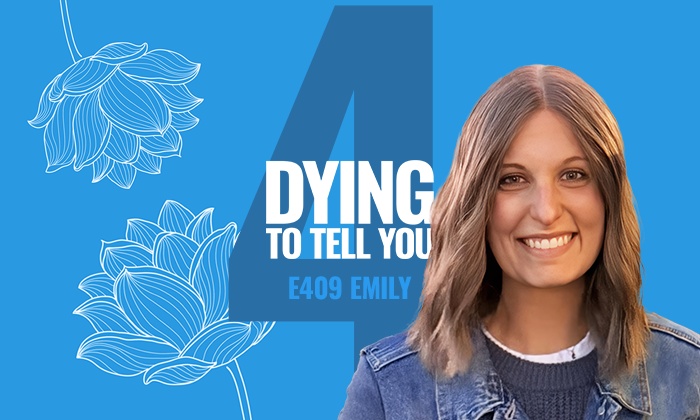
Listen and subscribe on Spotify or Apple Podcasts.
S4E409 — Who’s This Life For Anyway?
Emily [00:12] I hate that cancer is the reason, but I have, and continue to, become more of my authentic self.
Emily [00:22] I shouldn't admit this out loud, but I used to be really intimidated by helping presenters get on stage. And now it's so easy. You're like, everyone's a person. Everyone's a human being.
Emily [00:39] Post-cancer diagnosis, and I would say especially after the stage four rediagnosis, it's like, yeah, all bets are off. Because who am I doing this life for? Myself.
Cody [01:01] In March of 2023, Emily went for her yearly wellness exam with her gynecologist. She was doing a breast exam and asked Emily if she had noticed a lump, which she hadn't. It took Emily three weeks to get in for a diagnostic mammogram and ultrasound, and another three weeks to get in for a biopsy. During this time, nobody told Emily what they thought was going on, and she wasn't familiar with her online patient portal at the time, so she simply heard that they needed more testing.
Emily's mother had been diagnosed with breast cancer six months prior, so Emily, though she had hoped it was something benign, had a suspicion that something more serious was going on. But it wasn't until after the biopsy was completed that the radiologist walked back into the room and finally told Emily, who believed she needed to hear it in person, that she was 90% sure it was cancer. When the pathology came back, Emily was diagnosed with stage 3B triple-negative invasive ductal carcinoma. She went through an extensive treatment regimen, including chemotherapy, a double mastectomy, and 28 rounds of radiation. She says it was hard, but she never had any serious complications. The treatment left her with no evidence of disease, but also with difficult feelings about her experience as a patient and as a survivor.
This is Dying to Tell You.
Emily [02:36] It's funny, I always refer back to a moment I had with my therapist after all of my treatments were finished. This was in May of 2024, and I was getting ready to go to a camp for people in the breast and gynecologic cancer community. I told her, "I'm worried to go to camp, because I feel like there are so many people who've had such a hard time, and I had a relatively good experience with my cancer treatment." And she goes, "I'm going to stop you right there. You just said your experience with cancer treatment was good." And I was like, "You're right, that is an insane thing to say." And then she said, "Just because other people are seemingly going through harder things than you doesn't mean what you're going through isn't also hard." So that really helped.
But yeah, it went as well as it could have gone, right? Before I even started the AC, I had a PET scan, and I had a complete resolution on that scan. I achieved a pathological complete response at the time of surgery, which means there was no residual cancer. And I thought I was good. I thought my statistics were good moving forward.
Cody [03:56] Right. We have this tendency to compare. Everybody does, I think. And it is a little insane to say that you felt bad because your cancer experience was good, but I totally get it. I've been in chemo infusion centers, and you look around and there are vastly different experiences happening in that room. It would be hard, I think, for somebody who's having a not-terrible experience to go in there and not feel at least a little bad, because this other person over here is currently puking, you know? So, complete response, and you're feeling bad because you're doing so well, and you're going to your camp.
Emily [05:00] Mm-hmm. Camp Breastie. From the Breasties. The Breasties are all—
Cody [05:07] You thought you were completely done. Did anybody talk to you about the possibility of recurrence, or the likelihood of recurrence, at all?
Emily [05:20] Yeah. We talked about it with my oncologist, and he said, "Look, because you hit all of these marks, your chance of this happening is significantly reduced." We still did labs. He would scan me whenever I asked. I'd say, "Hey, can we do a CT scan?" and he'd say, "Yeah, let's check it, make sure everything's going well." We did that for a year. We were still monitoring. We weren't out of the woods yet, because he said the first goal is to get to one year, the second milestone is three years, and then five years. And the further out you get, the better your chance of not having a recurrence with triple negative.
At camp, I met such a wonderful group of people. One of them, my cabin mate, was also triple negative, but back in 2020. She had decided to have a risk-reducing, preventative salpingectomy [?] just to reduce her risk of any gynecological cancers. She did not have any genetic mutation. I did not have any genetic mutation. She said she had done some research and that there was maybe an increased risk there, and she wanted to reduce her risk. And I was like, that's really interesting. I'm going to ask my oncologist about this.
So this is spring of 2025 now. I asked my oncologist, and he said, "I honestly don't know. Do you want to talk to a specialist about this?" And I said, "That would be great." So he set me up with a gynecologic oncologist. I missed my first appointment with him, which, I always say this because it's so weird, is probably the only medical appointment I've missed since college. So I had to rebook two weeks later.
I go in and talk to him. He throws a lot of statistics at me. He says a lot of the statistics coincide with a genetic mutation. And I go, "That's great. I appreciate your statistics. But statistics said I shouldn't have gotten triple-negative breast cancer at the age of thirty-two." And he said, "I understand that. So let's go ahead and retest your genetics," which came back, again, with nothing there. And then he said, "Let's do a CA-125," which is a cancer antigen test that measures for ovarian cancer cells circulating within your body. He wanted to do that just as a baseline, to start our conversation. And it came back the next day elevated at 209, when normal would be under 36.
So he sent me for a stat CAP CT, which showed some nodes of concern in the lungs and the lymph nodes in the chest area. We had to send for a PET scan and then a lung biopsy. And then we confirmed with my oncologist that it was a recurrence of my triple-negative breast cancer.
Cody [08:33] So at that point it was a recurrence of your breast cancer that had spread to...
Emily [08:40] To my lungs and the nearby lymph nodes. So, to a distant site, which is what makes it stage four and metastatic.
Cody [08:49] Where were you when you found that out?
Emily [08:52] It's kind of interesting, this journey of finding out, because it took a while to get the PET scan results back. I was in Vegas for work when the gynecologic oncologist called, and he said, "We don't have the official results, but this is concerning, and these are probably what the next steps are going to be." So it's a little mental breakdown there, and then it's, okay, back to work.
And then we did the lung biopsy. I remember I had the biopsy on July 3rd, enjoyed the Fourth of July weekend, and then I made my partner open my results on my chart, I think on Sunday night. I said, "I know they're in there. You read them." We're standing in my living room and he says, "What do you want me to tell you?" And I said, "What does it say?" And basically he said, "Positive." And it's different, right, because it says positive for adenocarcinoma, which is essentially cancer of the lungs, but all of the other jargon says this is a triple-negative recurrence. We've done the pathology and everything. It's such a weird time. Then my partner left to spend some time at the family cabin up in the Northwoods of Wisconsin, because I was still—
This is a theme here, okay. First of all, with my diagnosis, I had my meeting [?] with my oncologist about this, and then I had to go to Vegas for work, which is full circle from 2023. So I'd gone into his office, and it was just me and him. And he comes in and he says, "What the ****?" And I go, "You took my line." But he had a packet of options for me.
Emily [10:50] He said, "Okay, this is what I want to do. We have to wait for more testing, but I'm going to push for this," which was Trodelvy with Keytruda, which is immunotherapy. But when it comes to stage four triple-negative breast cancer, your tumor cells have to be positive for a PD-L1 protein for immunotherapy to work. So we were waiting for that to come back. And at the time, Trodelvy as a standalone was not approved as a first-line treatment.
So I was operating for a couple of weeks, and I had to get a port replaced [?] because I hadn't taken mine out, under the assumption that we were going to start Trodelvy. Okay, these are the side effects, this is the schedule. The day before they could get me in for infusion, I get a call, and they say, "We will be giving you Taxol again." And I think I had a panic attack. I was swimming in the pool and I had a panic attack, because in my mind I was like, you are not giving me the state-of-the-art treatment you said you were going to give me. You're giving me something I've already had. Is it going to work? Why are we doing this?
Once I finally calmed down, I called the infusion center back and said, "I have questions." And the Taxol was essentially to buy us some time. Then once I had a little bit of progression in January, we were able to switch to Trodelvy.
Cody [12:21] I just want to go back and ask about that moment when your partner reads you the results. What was that moment like? Had you been expecting it?
Emily [12:38] I had hoped that this was something else. I had hoped it was Valley fever. I had joked with a friend that I hoped it was a new, different cancer, like a lung cancer, something local, you know? It was such a weird thing to joke about. And then we were rating cancers after that, which is, you know, a thing in the community.
Cody [13:00] I feel like you can do that, yeah.
Emily [13:04] And I'm trying to remember. I knew we had to talk to Curly [?], my oncologist, to get the confirmation, but I was heartbroken, because I knew this was going to change everything I had known to be true for the last year and a half, and how I wanted to move forward, and how we had been moving forward with our lives.
I do recall spending a little time with my sister in that in-between time, when I was waiting to get scheduled for the lung biopsy. She said, "What are you going to do if this is cancer again?" And I said, "Well, then we do it again." In my mind, there's no other option. We just do it. And she said, "I don't know how you can just think that way." And I said, "The other option is not doing it, and what good does that do me?"
Cody [14:07] What was she suggesting? That you just don't do anything?
Emily [14:15] No. I think she was just asking, mentally, how are you handling this? What if it's cancer again? And I said, then it's cancer again. I'm not in control.
[Music]
Cody [15:11] The stories we share here on Dying to Tell You are true. That's kind of what makes them so powerful. But true stories aren't the only way to explore life's mysteries. Sometimes it takes a story that's nearly true, which is why I'm excited to share a new podcast with you called Nearly True Stories: audio versions of short fiction, brought to you by the producer of Dying to Tell You, Chris Rock. You can find Nearly True Stories on Apple Podcasts and Spotify, and if you're a writer yourself, submit your short fiction to nearlytruepodcast at gmail dot com [?]. That's Nearly True Stories on Apple Podcasts and Spotify. And now, back to the true stories.
Cody [15:58] We all have, in our minds, a story that we've already written about how our life is going to go. And when somebody gets a significant diagnosis of any kind, but a cancer diagnosis particularly, it's like a plot twist. You don't really know where the story is going to go, but you know that the story you had in mind is not the story you're living at the moment. And you'd already started the process of seeing where the story was unfolding and directing where your life was going, and then it happened again, and you already knew, this changes everything. What particularly changed for you about life, or what you had in mind for life, at that point?
Emily [16:55] I think the biggest change is the mental factor of thinking: when, or if, is this going to take me out? Your own mortality is front and center in how you view the timeline of your life. But with that said, I have continued to try to live my life as normally as possible, if normal's even a word. As you can see, I'm here in Kansas City. I'm at work. I've chosen to continue to work. I really enjoy my job and my career and the people I get to work with. It's rewarding for me, and it's something I'm passionate about, so I'm going to continue to do that as long as I physically can.
And I'm going to continue to travel and put that into my schedule, because it's something we enjoy doing, and spending time outdoors and hiking and things like that. I'm learning to live with this, and it's more like living with the treatments right now than living with the cancer. I had minimal cancer when we found the rediagnosis, which I'm also very grateful for. Before I had any type of symptom, it was just caught at a really early stage four. And now, I mean, I've had one spot flare up recently, but for the most part there's no evidence of active disease in my body. And I keep reminding myself: if I can physically still do all of these things, I'm going to continue to do them until something changes and I can't.
Cody [18:51] Yeah. It makes sense. I guess the other option would be to pout, or, maybe that's not fair, to kind of pack it in and say, "Well, this is my life now." I have known people who have done that. But for the most part, I think people don't want to be defined by an illness, or even by a treatment.
Emily [19:34] Yeah.
Cody [19:35] Earlier this season we had a guy named Jonathan on, Jonathan Pascual, an ultramarathoner. And he's like, "Movement is medicine. I've got to keep doing what I'm doing, otherwise I'm going to stagnate, and if I stagnate, I'm going to die." He didn't say it in those words, but that was the gist of it. And it's really hard, and some days all he can do is get out of bed and walk to the bathroom, but he's going to do it. That seems to be helpful for people: to identify the thing that brings you life and just keep doing it. Keep moving, keep traveling, keep doing your work, whatever it is.
Emily [20:40] Yeah. I love that: movement as medicine. I use that a lot too, as a reminder. Every time I move, it helps a lot with fatigue and side effects and things like that. Someone once commented on a video of mine, "Cancer can't hit a moving target," and I was like, I like that. And community is treatment. Community is huge. And then nature's nurture, too [?]. Those are kind of my three go-tos.
Cody [21:11] I had a doctor I worked with a lot who would always say, in the context of being in the hospital, "Your body is designed to move, and if you don't, problems start to happen. So get up, move around." Is there anything we should know about your treatment process? You said it was in the spring of 2025 when you found the recurrence, and you've been in treatment since. Is there anything interesting we should know about that, or are you just doing your treatment?
Emily [21:54] There is a little interesting thing, and I think it happened right before we talked last. I'm not going to lie, when we talked last I was in a haze of just starting Trodelvy and a lot of stuff happening, and I don't really remember our conversation.
Cody [22:11] Well, that's fine. I'm sure you've talked to many more people.
Emily [22:14] Yes. But when I switched to Trodelvy, and I think this is a big part of my story and how everything has happened the way it has, a lot of things have happened for me and my treatment because other people have shared their experiences with me. It's a reminder that we need to share our experiences, because it can help someone else.
When I switched from my first-line Taxol to Trodelvy, someone commented on a TikTok of mine and said, "Hey, make sure to get a brain MRI." And I was like, okay, why? Because we hadn't done one since I was first diagnosed with the stage four recurrence. She said she'd heard of people who switched to Trodelvy who had brain mets, and they didn't see them. So, just get a brain MRI, because a PET scan doesn't show what's going on in the brain. The brain is always metabolically active.
So I asked my oncologist, "Can we do a brain MRI?" And he said, "Yeah, that's a great idea. We haven't done one in a while." And we found nine small lesions in my brain. Which, again, he was like, "What the ***?" And I was like, "It's not my line." And he said, "Good call on the brain MRI." And I said, why was it me who had the suggestion?
Cody [23:34] Yeah, no kidding.
Emily [23:36] But again, thank you, TikTok. Thank you, community. And so we did spot radiation, five rounds, and I've had clean brain MRIs since. That one was the scariest. The brain was the scariest for me, of everywhere it could go. And it's so interesting, because when that happened, I was like, okay, we have a plan. I trust the plan. This is life now. We just have to keep doing this and keep moving forward.
And it was weirdly, and maybe I hate to say this out loud, a sense of relief, because it was finally in the place I was most worried about. It's like people who really worry about recurrence, which, if I'm being honest, I didn't, in that in-between period. I wasn't always thinking, is this going to come back? But I've heard people say, not a lot of people, but I've heard people say, that when it does come, it's almost a sense of relief that the one thing they were worrying so much about just happened. So weird.
Cody [24:49] Yeah. Well, I could totally see it, though. If I were in that situation, the brain would be the scariest for me too. And if you're worried about it, and then it happens, and you look around and you're like, "It's happening, but I'm still okay," or "It's happened, and I made it through it, I did the thing, and now I can do that," I can see how it would be a relief. Even in the moment of worrying that something is going to happen, and then it happens, and you're just like, "It happened. Now I can move on. I don't have to worry about that anymore." Hopefully. Yeah.
Talk to me about community. Where are you finding community? I'm interested.
Emily [25:53] Yeah, that was a big one for me after the stage three diagnosis and treatment plan. You have the people who are in your corner, your family and your friends, but if you're not in the cancer space, you don't fully get it. And also, I don't want you to get it. I don't want you to understand, because I don't want you in that same scenario.
So I made a very quick decision in the spring of 2024 to attend camp, Camp Breastie, put on by the Breasties, which is an organization. I thought about it for a couple of weeks, and then I was talking to my partner and I said, "I think I need to do this. I don't know a single person, but I think I need to do this." And I booked the ticket, and then it sold out the next day. So it was perfect timing.
I went not knowing a single soul and was put in a cabin with eleven other individuals. To this day we still talk on a weekly basis. We all just connected. It was amazing to have a community of people who understood everything you're going through. At that time I was a survivor, and just being able to relate, especially with my friend who had TNBC. It also alleviates some of the cancer talk with the other people in your life who are still there and still want to support you, and who I think probably want me to talk more about it. But having a community of people who actually get it is just so nice.
And then when I went to camp in 2025 [?], this was after I'd had that abnormal CAP CT, and my PET scan was scheduled right when I got back from camp. I remember seeing people with stage four metastatic breast cancer speaking on panels and leading workshops in this community. And I remember seeing that, in the middle of my uncertainty, and thinking, okay, if this is stage four cancer, I can do this. Because look at these people. They're living their lives fully, so authentically. They're out there. I can do this, because these people are leading the way.
So now I have this community of people, and you kind of add on at every camp and every event. After the stage four diagnosis, I'm in an Instagram group chat. I've met more people at camp who are stage four thrivers, and I'm adding more events and advocacy opportunities to my calendar to connect with more people, because it's really great to connect with the people who get it. And I do feel like that alleviates some of the emotional burden on your other support system.
Cody [29:22] That's something I don't think I've heard before. But that does make sense, right? You're getting support from elsewhere, and that frees you up. As we were talking about earlier, nobody wants to be defined solely by their cancer or their treatment or their stage. If you're able to talk about that elsewhere, it frees you up to just be yourself with the people that you love.
[Music]
Cody [30:36] Something I wrote down in our first conversation was "don't ask about prognosis."
Emily [30:46] Yeah, okay.
Cody [30:46] I'm not asking you to talk about prognosis, but is that something you have talked about, or are you avoiding that conversation?
Emily [30:57] We have not talked about it. When I went into my first follow-up appointment with my oncologist, the "hey, this is stage four" appointment, I did not ask what my prognosis was. He did not give me a prognosis. All he said to me was, "I plan on having you around for a really long time," which I loved. And I don't revisit it. I don't ask. Maybe it gets to a point where I do ask, if things take a turn and go south.
But I think about how I've heard different doctors give different people timelines. "You have two to five years." "You have twelve to twenty-four months." And I feel like that is such a disservice to the patient, because you're putting something in their brain that they're possibly holding on to. I mean, there are people out there who say, "Screw your statistics, I'm not taking your two to five years." But not everyone has the ability to do that. And so now you're putting this thought into their brain, so why wouldn't they be thinking, I only have this amount of time left? I don't want to know. He never gave me a prognosis, not to this point, and I don't ask for one. All I know is what he said, that we can continue treatment and everything.
I saw something a while ago that resonated with me, and you've probably heard it: anyone could get hit by a bus tomorrow. So it's living your life more like that, I guess. I'm making decisions like, I have stage four cancer, whether that's a number of years or thirty years or whatever, and I'm living my life just how I want to live it and experiencing every single day. Sometimes, mentally, I live about six months of planning at a time, just because that's what I can feel confident in, health-wise. Anything can take a turn at any moment. But for me, it's helped me not to have someone put an expiration date on me. And who's to say, it could eventually come to a point where things get harder and that conversation does come up. But where I'm at right now, I don't feel like having a conversation about prognosis would be beneficial to me, or to how I choose to live my life.
Cody [33:50] Yeah, totally. I get it. And honestly, I think those of us who aren't living with a terminal illness could probably benefit from living a little more like that. Like, hey, I might get hit by a bus tomorrow, or I might have a heart attack tomorrow. And I also want to plan for what might be down the road. It's hard to do that, because I don't actually know what's going to happen down the road.
I can also see how it might change if you start feeling bad, or if it starts to hinder your ability to do some of the things you're doing now that bring you life and joy. It might change your desire to talk about what life looks like, especially the longevity. But maybe not. Maybe you just go along and figure it out on your own. I think most people can tell when their body is changing and when life is changing. And luckily you caught it before it was really changing your life. So, good for you. You just keep doing what you're doing.
Emily [35:22] A fluke [?]. Yeah.
Cody [35:23] Yeah, seriously. Do you think there's rhyme or reason or purpose? Is there somebody up there playing chess with our little chess pieces? Or is this a fluke, just the way things happen because that's the way the world is?
Emily [35:47] I'm a firm believer that everything that has happened in my life has happened the way it's supposed to. And not just the cancer of it all. Every decision I've made has led me to where I am now. And I feel like there's a reason I missed my first appointment with the gynecologic oncologist, and why we didn't meet for two weeks. Do I know if the CA-125 would have been that elevated, or would have changed that drastically, in those two weeks? I don't know. But I feel like there's a reason it aligned the way it did, that we found it early the way we did, so that someone could say "get a brain MRI," and we found that the way we did. Whether that's fate, or God, or a higher spiritual being, or the universe just aligning the way that it is, I look back and I think, as much as a lot of this sucks, this was part of my life's plan. As much as I don't want half of this part of my life's plan.
But I even go back to meeting my partner and how we met and how everything aligned there, and my decision to leave the Midwest and move out to Arizona for work. That all is a timeline that was meant to be. And unfortunately, cancer was a part of the story. I don't know what that means for the future, but it's made me evaluate my life and what I'm doing with it, and also what I could be doing with it. I'm not saying I'm supposed to have some greater purpose. Maybe. But I think there are things I can be doing within communities to do better for the world. And that's starting to really get into advocacy, especially for breast cancer, and especially stage four metastatic breast cancer.
Cody [38:16] Did you have this kind of worldview, that everything is happening the way it's supposed to happen, before you got cancer?
Emily [38:27] I did. Yeah. There were moments where I could have made completely different decisions, and that would have taken me on a different trajectory for my life. And I didn't, right? I made these specific decisions, and this all happened the way it was supposed to.
Cody [38:51] Do you think that helps you accept that you have cancer, accept the reality the way it is? Is that helpful for you?
Emily [39:08] I think it is helpful for me. And since we spoke last I've been thinking about it, and for me there has to be something bigger than this. I don't know if I necessarily felt that eight months ago, but I'm like, the universe has to be bigger than this world we're living in right now. I believe there has to be something beyond. And I think that's helping me navigate this.
Cody [39:43] Mm-hmm. This life.
Emily [39:47] Beyond this life. Yeah.
Cody [39:49] Interesting. And maybe that's a new thought, or one we haven't really...
Emily [40:02] It's resurfaced in recent years [?]. Yeah.
Cody [40:05] Ideas about what it is. What is going on here?
Emily [40:14] I don't know yet, but we have to be spirits or souls or something, and these are the bodies we're given. Because really, it's like, what's going on up in here, up in your mind.
Cody [40:33] What do you hope is going on?
Emily [40:37] After this?
Cody [40:38] Yeah.
Emily [40:41] I mean, I hope there's a heaven. I hope there's somewhere we continue to live on in our consciousness, and maybe that's a different vessel. I don't know quite what that looks like. But I hope, and I believe, that it's not just black once you're done on this earth.
Cody [41:04] You know, it depends on the day, but I'm having more days recently where I'm thinking there's something else going on. I'm always hopeful, but...
Emily [41:16] Yeah.
[Music]
Cody [42:16] What else do you want to say? Anything we haven't talked about that you want to talk about?
Emily [42:23] I think I just blacked out for the last hour. I was actually on a panel at this last camp, Camp Breastie, which was a great experience, to speak in front of people live for the first time.
Cody [42:45] Look at you.
Emily [42:46] Because I'm always behind the scenes. I'm behind the curtain. I'm behind the stage. And for the first time I was out on stage. And something about this, I hate that cancer is the reason, but I have, and continue to, become more of my authentic self and present myself in an authentic way. I do appreciate that, and I do at least enjoy that I'm not limiting myself, or reducing who I am as a person anymore. I'm like, this is me.
Cody [43:24] Mm-hmm. How's that showing up?
Emily [43:27] It shows up, first of all, on the internet, on TikTok, and in sharing my story there. But even just at work, I feel like I have less stress now and I enjoy it more. I used to be, and I shouldn't admit this out loud, really intimidated by helping presenters get on stage. And now it's so easy. You're like, everyone's a person. Everyone's a human being. This person isn't any different than I am. They're just as nervous about going out there and speaking and interacting with those people. I don't want to say I care less, because that's not the appropriate term, but I don't have as much anxiety about it, or about my job, or about my goofiness and how I present myself.
Cody [44:31] Yeah, nice. I don't know if I can articulate it, but I'm having this thought about maybe a parallel process. When you had the anxiety about brain mets, and then you had the brain mets, and then relief, I'm wondering if there's a thing that happens, because I've seen this happen for a lot of people. There's some level of adjusting oneself to fit in and to be who somebody says we're supposed to be. And then a big diagnosis, or something else big, happens, and you're faced with your own mortality, and then all bets are off. They are who they are, and it's a kind of relief to shed the expectations everybody puts on them. Do you find that to be true?
Emily [45:41] I do. I do find that to be true. I feel like post-cancer diagnosis, and I would say especially after the stage four rediagnosis, it's like, yeah, all bets are off. Because who am I doing this life for? Myself. I'm not doing it for other people, right?
Cody [46:04] And by the way, me too. Even though I'm not in the same situation, it's the same.
Emily [46:13] Yeah. Everyone should actually be asking, who are you doing this life for? Yourself. None of us get out of it alive.
Cody [46:21] A hundred percent. Everybody I know will die. I guess I really hadn't thought about it in that way before. I don't know what to say about it. I want to say that's cool, but it's not really cool. But it can be cool.
Well, the last thing I always ask people, and we kind of talked about afterlife stuff, but the other thing is, how do you want to be remembered?
Emily [46:59] Mm.
Emily [47:01] Remembered as someone who brought joy to people's lives. I'm a very sarcastic person. We always joke about how I grew up with a cold heart and all this stuff in my adolescence. But I hope people think of me and say, "She was authentic. She made me laugh. She brought joy, and she was loyal, and she loved so much." That's a whole other podcast for a whole other time, my adolescence and how I got through that. Maybe we should have led with that.
Cody [47:40] Yeah, maybe.
Emily [47:41] Sorry. But yeah, that's how I want to be remembered. That I wasn't afraid to love, and to appreciate small things, and to laugh and joke and bring joy. And that I was loyal.
Cody [47:59] Has that intensified through your diagnosis?
Emily [48:07] It's intensified.
Cody [48:10] Yeah. Well, thank you for joining me from your hotel room in Kansas City. Beautiful. Go eat some barbecue. Are you a barbecue person?
Emily [48:27] Sometimes. Yeah. I mean, in Kansas City, you've got to seek it out.
Cody [48:30] Yeah.
Well, thank you so much for taking the time. Tell everybody your Instagram, TikTok.
Emily [48:41] Ooh, yeah. My Instagram is @E-A-C-R-A-I-N [?]. And I have to look up my TikTok. Yeah, it's the same. @E-A-C-R-A-I-N. Try to keep it seamless across platforms.
Cody [48:58] Yeah. All right, cool. Well, we'll put it in the show notes, and people can find you and follow you and see all the cool things you're doing. Camp Breastie. Kansas City. Las Vegas, apparently [?].
Emily [49:09] Kansas City, yeah. And Vegas. A lot of Vegas.
Cody [49:17] All right, cool. Well, thank you so much.
Emily [49:20] Yeah, thank you.
Cody [49:27] Thank you to Emily for taking the time to tell your story, especially in the middle of a work event from your hotel room. We're getting close to the end of season four of Dying to Tell You, and I just want to say how grateful I am for all of our listeners, supporters, and guests. Thank you all so much for participating in this project. Mortality really does have a clarifying effect, but you don't need to be dying to look up, to find what matters, and to live your life with intention and purpose.
