
S4E405 - Transcript
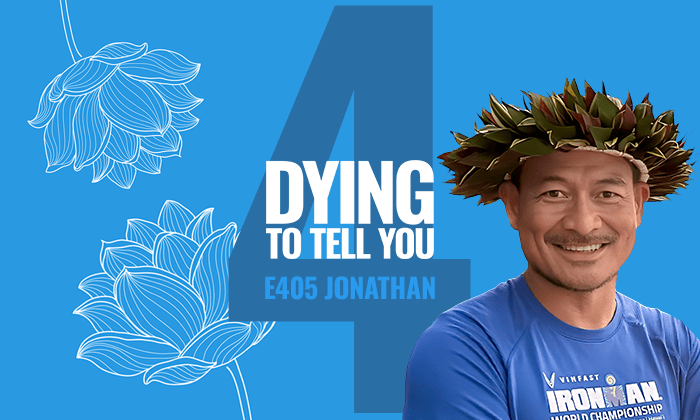
Listen and subscribe on Spotify or Apple Podcasts.
“Movement Is Medicine: How an Ironman Faces Stage Four Cancer”
Jonathan: I describe myself now as being in this Sisyphean journey — I push the rock up the hill, and over and over again, over the last three and a half years, it rolls back. It flattens me. I can't move. I don't want to get out of bed. It hurts too much. I can't even run — I'm so short of breath. But then, what do I do? I push the rock back up again.
Cody: My guest this week is Jonathan Pascual. Jonathan grew up in the Philippines and moved to Hawaii in his teens. He started his medical career working as a nurse there, then moved to the San Francisco Bay Area at 24 to further develop his skills and pursue career advancement — but also to seek self-discovery.
At UCSF Hospital, Jonathan worked as an ICU nurse. He had mentors who helped him develop his skills as a nurse and a leader, eventually becoming an expert in cardiac devices, and then in ECMO — extracorporeal membrane oxygenation — during the H1N1 outbreak. After working at UCSF for 14 years across multiple roles, Jonathan decided he wanted to learn more, so he went to the UCSF School of Nursing to become a nurse practitioner. In 2014, he became a lung transplant nurse practitioner, working with some of the sickest patients in the hospital. Jonathan is no stranger to serious illness — while many of his patients were able to get to transplant, many were not, and Jonathan was present to help them as they came to the end of their lives.
The tenacity with which Jonathan pursued his medical career is the same tenacity with which he is living his life with his own life-limiting illness. I appreciate his commitment to living his life to the fullest, and facing his illness and mortality with clear thoughtfulness. I hope you do too.
This is Dying to Tell You.
Jonathan: It was March 24th, 2022, that I was diagnosed with mediastinal paraganglioma, stage four. What led up to that diagnosis was that I was feeling short of breath, and I'd wake up with my face really swollen — even though my body was starting to take the form of somebody reaching race weight, because I was training for Ironman triathlons and 100-mile ultramarathons. It didn't make sense that my body looked fit, but my face was puffy, like I'd gained weight.
Later on, I'd wake up at night gasping for air. What really pushed me to go to the emergency room was that I'd get up from a sitting or lying position, my vision would go dark, and I could feel myself falling like a log — and then, boom, I'd crash. That happened a few times before I actually went in.
I was concerned that something was definitely wrong, and those symptoms happened over a span of at least three months, maybe more. But being an endurance athlete, I always chalked it up to, "Hey buddy, you're not training hard enough — you can overcome this." On the day I finally went to the emergency room, I remember thinking, "Do I really want to go? I have a 22-mile run today. I did a 20-miler last week. I'm gonna be sitting there forever." But it'll be okay.
Cody: It's so wild to me — it's so interesting how easily we talk ourselves out of going to the hospital. Even you — an accomplished athlete, in good shape — shouldn't be having dizzy spells, passing out, swelling in the face. And you just do these mental gymnastics to talk yourself into "I'm gonna be okay, I'm just not training hard enough." What is that about? Why do we do that?
Jonathan: We default to what we've done in the past, based on our experience and our knowledge. There's also this fear for some people that if you go to the hospital, they'll find out something's wrong — but that's the whole point of going.
Cody: It's funny — you make a good point. We default to what we've always done. I've heard so many people say, "I was fine, I've never been sick before." And in my mind, I always think: we're all fine until we're not fine. That's really the case. We think we're fine because we've always been fine up to this point. Most people don't think "cancer" — they think, "the last time I had a pain it was nothing, so this time it's probably nothing too." Defaulting to what we've always known. Good point.
So — for three months you're having dizziness, swelling, lightheadedness, you're passing out — and then you go to the emergency room. Tell me about that process. You went to your own emergency room?
Jonathan: Yes, I went to UCSF.
Cody: Interesting dynamic, I imagine.
Jonathan: Yeah — the value of that was that I had my iPhone, so I had access to read all the lab tests, echocardiograms, x-rays, and CT scans before anyone came to talk to me. I was looking at my x-ray, and the mediastinum — the area in the center of your chest that contains the heart and the big blood vessels — was pretty wide. I thought, could this be it? Something wrong with my heart, too enlarged, or something with the aorta? All these etiologies going through my head. I knew, being a clinician, the next step was a CT scan.
So I got the echocardiogram — that was fine. Blood work — always fine.
Cody: Of course.
Jonathan: Right. Nothing wrong with the chemistries or the complete blood count. Then, scrolling through the CT scan, I said — this is cancer. More than likely, 90% or more, just by the way it looked. I'm not a radiologist, that's not my training, but I've seen hundreds and thousands of scans myself. I could tell — there was this huge mass on the right side of my chest, extending all the way up to my neck. Clearly a tumor. And there was this density that was clearly a tumor. Later, the more you look at the scan, the more you see — something in the lungs, something in the bones. Even before the doctor came in and told me I had cancer, it was still pretty surreal to actually hear those words.
Cody: What an interesting dynamic — as a clinician, you see the scans, you already know. And then to have somebody come and tell you, "yes, you have cancer" — even then, it's still a surreal moment. I can imagine how strange that is.
Jonathan: Yes. He told me that what I was experiencing was superior vena cava syndrome, caused by the tumor in my chest — the big vessel called the superior vena cava was being blocked by the tumor, extending to the subclavian and internal jugular veins. Because of those blockages, whenever I was in a dependent position — horizontal, like swimming or lying flat — I didn't have enough blood drainage to return blood from my face, neck, arms, and upper chest back to circulation. That's why there was swelling. And I had reduced cardiac output, so when I changed position quickly, I didn't have enough blood pressure going back to my head — that's why I'd pass out.
When he told me, I was quite calm. I didn't have shock, denial, anger, or bargaining, because I'd been through that before — I had a brain tumor in 2007 that was surgically removed. My past experience influenced my reaction. I defaulted to: alright, I need more information.
[MUSIC]
Cody: That was 2022 when you were diagnosed. It's 2025 now. What have these three years been like for you?
Jonathan: To address the cancer itself — I went through radiation to shrink the tumor, which at its biggest was about 8.7 centimeters. That's big, especially pushing right near your heart. The goal, Cody, was to kick the can down the road, and to live my life as normally as possible. I did very well — lots of ups and downs during treatment, but within those two years, through training and racing marathons, ultramarathons, and triathlons, I peaked at the Ironman World Championships in Kona in October 2024.
Two months later, I was in the ICU with blood clots in my lungs and arms, on very powerful medications to dissolve them, and going through interventions to have them removed. The decline has been slow over three and a half years, but much more so since December. By May of this year, I started a clinical trial at the National Institutes of Health in Bethesda, Maryland — chemotherapy plus a study drug, a PARP inhibitor. Seven days on chemo, fourteen days off, on and on.
That's what led to my retirement in March. After December, being in the hospital, I went back in January and February and said, this is really getting hard. I needed to focus on the job I put on myself — what I call my "cancer ship." There are six pillars to that.
Cody: Cancer ship. When we talked before, you said a big part of the reason for retirement was that things were getting hard — but specifically, keeping things straight in your mind. Is that right?
Jonathan: That's correct. There's real mental strain, because transplant medicine is hard — any medicine is hard, but you have to know the details, not just the big picture. You really have to know what's going on with your patients, and it takes time to study, even outside of clinic. You're at home, and you're still getting messages from nurses — used to be pages, now it's something else. And you're asking yourself: do I keep giving back to my patients and my team, or is it time to really focus on myself and my family?
The decision was easy to make because I'd already checked that box — I was out of work for over a year during treatment, and I told myself, I'm going to go back, I'm going to serve more, that's my purpose. But once I'd done that, it was time to find other means of being purposeful and meaningful.
Cody: I want to talk more about that. You mentioned kicking the can down the road — I assume, as a clinician, you knew from the beginning this wasn't a curable cancer, that you'd live with this for the rest of your life.
Jonathan: Yes. In March 2022, the attending oncologist and his fellow were there, and I remember the fellow describing it: this is terminal, and you have about five years to live. If you had pancreatic cancer, you'd have about six months; bladder cancer, about ten years — I was right in the middle. That was the gist of being told about my terminal diagnosis.
Cody: Was that a surprise to you, or no?
Jonathan: No, because I take information as it comes. I try to practice equanimity with the information I'm given — step back, think things through, and ask what's next, what can we do now.
Cody: I find it interesting — you continued training physically, doing the Ironman, getting those championships even after your diagnosis. The sense I get from you is, "diagnosis be damned, I'm doing this." And even now, going through chemo, you've talked about the importance of getting up and moving, even though chemo can drain you and there's pain in the bones. Can you talk about why that's been so important, and how it's played out for you?
Jonathan: As a 24-year-old ICU nurse, I realized early on that when life hits your heart and you don't know what that's going to be, you'd better be prepared for it. So I had that thought process early, and I have to thank my younger self for training — moving and developing my mind and body through training for endurance events.
In 2007, when I got my brain tumor, my son was four years old. The most difficult, most painful thing at that time was knowing I might be leaving my family behind. I was 37. That's when I started thinking about — through stoic philosophy — the development of mind and body that helped carry me through.
So the point is: movement itself is medicine. I describe myself now as being in this Sisyphean journey — I push the rock up the hill, and over and over again, over the last three and a half years, it rolls back. It flattens me. I can't move, I don't want to get out of bed, it hurts too much, I can't even run, I'm so short of breath. But then, what do I do? I push the rock back up again. The lesson isn't pushing the rock blindly — the lesson is that movement itself is life. Movement itself is defiance. That's who I am, and that's why I've mentally and physically defaulted to action. Even during the most trying times, when there's no energy, I take little steps, and the little steps get better — I move a little farther out into the garden, and it builds up over time.
[MUSIC]
Cody: Was that something you grew up with — something already within you — or did it come through that ICU work, seeing that life comes at you and you have to be prepared?
Jonathan: I love that question. It brought back memories of being the asthmatic, scrawny kid — in my culture, kids would laugh at each other, sometimes not meanly, but sometimes meanly, because of the way I breathed — this whistling breath. I felt weak, and I didn't like that. I guess I thought, "I'm gonna show you." That's where the defiance came from. But it needed to be put into practice — I remember my father and I would take trips into the mountains, hiking and camping, bringing supplies, hunting and foraging for food. That was the adventure. It pushed me to move and not complain, because I wanted to show my father I could be tough like him.
Cody: All this talk of movement reminds me of a palliative doc I worked with who always said the body's designed to move, and if you're not moving, things go wrong — bedsores, pneumonia. Even a couple of days in the hospital and you walk away weaker. He used to say every day in the hospital requires three days of recovery. So your commitment to movement, even though it's hard, is probably helping you mentally, emotionally, spiritually — and physically.
Jonathan: Oh, absolutely. I had this thought: if I continue to maintain or even improve my physical condition as I continue to deteriorate, the better I'll be able to handle that deterioration — the chemotherapy, the side effects. It was always a theory, until I started getting chemo. I had no energy, brain fog — I used to read about brain fog and think, what does that even mean? GI side effects, no appetite. I realized there are ways to manage those with medication, but there are other things beyond what a doctor can prescribe.
I redefined what the seven days of chemotherapy could mean: a time of movement, a time of travel with plenty of safety precautions, a time of managing the highs and lows of energy and nutrition, and still continuing my connections with my support systems. I came back a couple of weeks ago from a week-long trip hiking in Pennsylvania and the Hudson Valley — while going through chemotherapy. Before that trip, I was at home, sitting there thinking, I don't want this brain fog, I need to be critical in my thinking, I need to be stimulated by nature. That was the theory, and I proved it — I can redefine how things can be.
As an athlete, you develop the ability to zoom in and zoom out. You don't have to be an athlete to do that — to zoom in on how you're feeling right now after treatment and say, this is just too hard. But I'm attuned to myself enough to either toughen up a little and take that step out of bed, or have the grace to say, I don't have to be the athlete I was before — I need to be patient.
Toughness isn't about being macho or bravado. Toughness is having kindness toward yourself, saying, "today you need rest" — because in training, rest is part of the training. You don't gain from just digging yourself into the ground. There were days getting radiation where I was just wiped out, and I had the grace to say, today it's okay, you can sit on the couch. You don't have to do what you were doing before — two, three-hour hikes were my baseline; some days it was just a walk, and that was okay too. It's periodization, like in training — there's a stimulus, whether that's the training or the treatment, and it's hard on the body, but you keep the big-picture view: where is this going to lead me? What's my goal, for myself, my family, my community? Really analyzing your life — where is this treatment leading me, what's important to me. I think I learned all of that from being an endurance athlete.
Cody: Zooming in and zooming out is such a useful tool for anyone, whether you're sick or not. When you're in the midst of something difficult, the ability to zoom out and remember it's not always going to be like this — there's a goal, there was a before — that's really helpful. And zooming in, breaking things into tiny portions — I can't run a mile today, but I can walk to the couch — that can be really helpful too.
Jonathan: When I was in the hospital, I had to come up with a plan for how to manage my cancer ship. The six pillars are: Western medicine — the language I speak, being a lung transplant nurse practitioner. Complementary medicine — yoga, exercise, massage. Nutrition, which is very important to me — in transplant medicine, I can't even transplant somebody who's severely cachectic; we tell them, you need to gain weight, gain muscle, so I know the importance of nutrition. Exercise, which we've talked about plenty. Rest, which we've touched on — needing rest to gain the full benefit of the work you put in. And support systems.
The support systems piece is interesting to me — I remember, even before I was diagnosed, several years after my brain tumor, telling my wife, "Honey, I'm afraid I'm going to die alone, or lonely." She said, no, no. Then in 2022, there was this barrage of information from people — family, friends, colleagues — all asking how I'm doing, and I needed a way to manage responding to people. That's when I went to Instagram, at @jpconbrio.
I started writing, connecting and reconnecting. It's been incredible — over these three and a half years, meeting kindergarten classmates, high school and college classmates, teachers and professors I hadn't seen in 20, 25 years, my endurance community of triathlon, cycling, running, and even strangers, like you. And other people from around the world continue to reach out because of what I've put on Instagram. I do a little bit of writing there, in a very limited space, and people — whatever stage they're in, whatever troubles them — find something meaningful for them. That is my support system. I've become part of their support system too.
Cody: That's one of those mutually beneficial relationships — you're getting support from those people, but in return you're giving support to them as well.
Jonathan: Absolutely.
Cody: Very cool. You mentioned stoicism — something I came to later in life and really appreciate. How did you find stoicism?
Jonathan: This was after 2007, when I realized life can be taken away from you at any moment. I thought about how I was going to live my life — there was a time when I was bargaining, saying, "please God, give me more time with my wife and my son, please give me 60 seconds to feel that amazing feeling of running," because I had this brain tumor and it was painful every second I was awake, like someone was hammering my head.
I realized there's this concept — memento mori. Remember, you are mortal. That led me to Seneca, Epictetus, Marcus Aurelius, and all that reading, many years ago. It requires time to practice — it's not something you read briefly and it just makes sense. You need to be tested by the difficulties in life, to show what you've actually learned. Luckily, I've had a privileged, healthy, good life — but when I get sick, it's going to be big. I had a brain tumor. Now a terminal cancer. I do it big.
Cody: Could you summarize stoicism for people who may not know much about it?
Jonathan: One of the main points I've taken from this philosophy is: I don't worry about things that aren't within my control. But for the things that are within my control, if I'm not resourceful enough myself, I find people who are smarter than me to help figure things out — or at least ask the right questions to keep me thinking toward solutions.
Second: remember that many things are impermanent. You marry yourself to something important — a place, a job, a relationship — and then sometimes you get sick, you lose your health, and suddenly that thing isn't so important anymore. You need discernment, and respect for that impermanence. When I was diagnosed on March 24th, 2022, I started what I call the Art of Dying, which I think is a very stoic principle — living my life as if I'm dying. Living with courage, the way I've always lived, but accepting that things will go wrong, and can go wrong, and adjusting as that progresses.
Cody: I think it was Seneca or Epictetus who said the most important thing is discerning between what you can control and what you can't. What I'm seeing from you is exactly that — you can't marry yourself to a job, to your abilities, to your ability to run a marathon or get out of bed, because those things can be taken away, just like everything else in life. The ability to know that, and accept it when it happens — you can't place a value on that. It's so hard to do. To get a diagnosis and go, "well, that's the way life is now, I can't change that, what am I going to do about it" — that's really what I see from you.
Jonathan: You took the words right out of my mouth — those are literally the words I tell myself: "What are you going to do about it, Jonathan?" Things can go wrong, and I've gone through many of those things, and they'll happen again, and it always comes back to that question.
And then there's the clinician's answer, but also the person's answer — I can't be someone who tries clinical trial after clinical trial, treatment after treatment, just to prolong what's inevitable and suffer through it. I'm not going to do that to myself, and I'm not going to do that to the people I love most, because they'll go through that suffering with me, whether I like it or not — they're going to see me go through it. So there's discernment there — I'll make the final call on what treatments I still want, and which ones I don't. A big part of this is a collaborative relationship with my physicians. And a big part of it is preparation — for my wife, my son, my mother, my stepdad. Those are hard conversations, but I'm fortunate to have the insight and the time to tell them: this is what's going to happen, this is what's happening to my body right now. And when I get to the dying process, I have ideas of how it's going to go, and they don't always pan out — we're clinicians, we know, best-laid plans. But I want to tell my family, this is how we're going to deal with the dying process. There's a pathway, and we'll make the choice, and they'll respect it, they'll honor it — because I've been preparing them. We've been having these conversations.
This is the Art of Dying, right? Living well and dying well are so deeply connected.
Cody: Of course they are.
Jonathan: You cannot remove one from the other. You cannot deny your mortality — or, at least for me, there's an ability to embrace it. And with this diagnosis, it's given me so much clarity. Clarity gives you so much freedom.
Cody: What's the clarity? What's become more clear for you?
Jonathan: I had premonitions. About three and a half years ago, I was so fatigued, so tired, and I said to myself, I'm ready when death comes for me. I'm okay. I've lived an examined life, I've been a force for good, I've given myself, I've helped others, I've lived a life of service.
There's this premonition — I was in a hospital room, talking to a chaplain I worked with. It was just an image: I was sitting in one of those tall, upright chairs, talking to my chaplain. And that actually happened — when Jamie, my chaplain, came into my room in the hospital three and a half years ago, and we had this conversation. What I shared with him was that from that moment on, I wanted to live my life with gratitude, meaning, acceptance, compassion, and forgiveness. He affirmed that I was coming from a place of love — when you hold yourself to those higher values, they become your guiding principles, not just for yourself, but for how you conduct your life and treat others, with kindness and compassion.
Cody: You mentioned that a big part of your meaning and purpose came from your work, serving people in the medical field, and that when you retired, you'd need to find new ways to find meaning and purpose. What have you found?
Jonathan: There's the mundane — and that's a special gift. Day-to-day living that you'd think could be boring. The last two days, I put up new security camera systems throughout the house, inside and out. I wanted to fix little things — this light isn't working. And sitting at home with my wife, sometimes in silence, just presence — that's very important to me. For somebody who likes to be moving for hours, for miles and miles, I know the value of being still. I know the value of solitude, of being in nature, at peace with myself. That's meaningful, that's purposeful — focusing on myself, my friends, my family.
But then there's the bigger picture of continuing to be a force for good. For me, that's come through raising funds for cancer research, for the Pheo Para Alliance — a small group of people who help clinicians and patients with rare cancers like pheochromocytoma and paraganglioma. About three years ago I developed a race called JP's Backyard Ultra and Hike — a 3.3-mile loop in Skyline Wilderness Park, where I used to train for my 100-mile runs. People can hike that 3.3 miles, one loop, all the way up to ten loops. I became a race director — I don't know why anyone would want to become a race director, but maybe it's because you want people like me to chase their dreams. Race directors are amazing. I also had to learn how to raise funds. We held JP's Backyard Ultra, had more than 600 participants, and raised $90,000. Every dollar goes to patient education, seminars, creating centers of excellence at different hospitals, not just in America but around the world — because my cancer is rare enough that we're called "zebras." Two to six people out of a million get it.
That's been a really important part of continuing to be a force for good, and it's part of the message I gave in my speech before the race start — especially to the young people. I challenged them to find themselves, whatever that means. It doesn't have to mean being the best athlete, the best artist, the best professional. It can mean being the best son or daughter, the kindest neighbor, choosing compassion and kindness, giving so much of yourself even while you're struggling. That's what I try to embody.
[MUSIC]
Cody: Jonathan, thank you so much for being so generous with your time. A couple of last questions we ask everybody — but before that, is there anything you wanted to say that we haven't talked about yet?
Jonathan: Oh, gosh, I've said so many things. I do think we live in a world that tries to pull us apart — these are very difficult times, mentally and physically. But whatever your beliefs or leanings, there are still so many things we have in common — and, cliché as it might sound, it's our humanity. I do think that showing kindness and compassion to others actually takes courage, because we always put up walls, we want to be right, we want to be in the power position. What's so much more powerful is not resisting that ability to connect. We didn't always live in a world this divided — and I'm not going to be apologetic for saying that. But I think I can communicate with people, whatever their leanings, and find our commonalities, and make a difference — not just for ourselves, but for our community. There are so many things we can work on for the good, for being a force for good, and I believe in that. I may just be raising funds for cancer, but I've developed a community. We can set aside our differences, but for at least one day, or maybe more, we're able to enjoy each other's company, enjoy nature, communicate, be respectful, and be kind to ourselves. Kindness's greatest power is in extending it to others.
Cody: I think that's what kindness can do for a lot of us. More kindness and compassion is certainly needed right now. Okay — last two questions. Thoughts about the afterlife — do you think there's something on the other side? You mentioned "the next life" earlier. What do you think?
Jonathan: My upbringing is Catholic — I was baptized in a Methodist church but educated in the Catholic church. I had nuns teach me piano, and they'd whack my fingers when I made mistakes — that's why I'm so disciplined. Some of my teachers, and my principal, were nuns. There was a point when I seriously considered priesthood, so I'm very familiar with the concepts of heaven, purgatory, and so on. So — is there an afterlife? Honestly, "I don't know" is the easy answer that comes to me naturally. It's not really the influence of that Catholic upbringing so much as my acceptance of the different ideas and religions I read about growing up — Buddhism, Shintoism, and later, stoic philosophy, which is very much tied into religion. So — I don't know. But this I can tell you: heaven is here on earth, and hell is here on earth too. Those are common expressions, but what's my experience? Being retired, being able to do the little things I like, being able to travel, answering my phone when I want to — I'm living a life of luxury. I don't have to be connected all the time. I have family and friends I can spend time with. That's heaven to me. Or I could make it hell.
Cody: I was just about to say the same thing. It's about choice.
Jonathan: It's the choice. I could marry myself to my phone all the time and be fed fear, hate, and anger all the time — I know that for sure. I'd like to think I'm smart enough to know how these things affect my dopamine release and things like that.
I do think I've done what I can to make things right for me, and how I treat people. I may not be religious — but I pray, that's for sure — and it's the way that I treat you, how I make you feel, how I make you think and challenge you. That's what I did here. So whether I live another life in the afterlife or not, I don't know, but at least I've been doing this life the way I wanted to, rightly for me. Let's just see how it's going to be — the next life.
Cody: I think what you said earlier about finding beauty in the mundane — enjoying fixing your lights, putting up your cameras, spending time with your wife — that can easily be heaven for you. It can be heaven or hell, and it's a mindset — you can find the beauty and pleasure in it, or you can turn it into a chore and it becomes hell. I really liked what you said earlier about seeing mundane things as meaningful, as purposeful. And the last question: how do you want to be remembered?
Jonathan: Alfred Nobel was mistakenly given his own obituary once — I believe it was meant for his brother — and he read it. This is the guy who invented dynamite, and now we award the Nobel Peace Prize, probably because he had a lot of regrets, since his invention was designed to blow things up. As far as I understand, that changed him. I don't want to be remembered for something like "oh, he did this, he did that" — but by how I treated people, by how I made them feel. Did I inspire them, or provoke them into thought, challenge them, help spur them into action — not just through my words, but through the things I did, how I conducted my life?
I think that's a simple way to put how I'd like to be remembered. We're a mosaic of many different people's perceptions of us — my endurance friends will remember the adventures we did together; my colleagues from UCSF will remember me as a mentor, a provider, a healer; some people, through social media, have told me I'm an inspiration to them. It's really important how we affect other people's lives with our actions and our words, and propel them toward something good.
Cody: I think the place we live is a very individualistic place, and paying attention to how what I do affects other people is important — I think we've lost some of that consideration for others. So, yeah — thank you. Thanks for sharing that.
Jonathan: Thank you. Thank you. I appreciate you.
Cody: Well, thank you so much again for being so generous with your time. I know it can be difficult to sit like this for this long when you're living with an illness like you are, and I know time is precious — so thank you for giving so generously. Thank you for your time, and for what you do, and for being who you are.
Jonathan: Well, thank you, Cody, so much for this opportunity. This truly has been a wonderful conversation.
Cody: If people want to donate to your cause, is there a website, or can they just follow you on Instagram — how would they keep track of that?
Jonathan: Primarily, they can follow me on Instagram — that's where I make announcements, like when the race is happening again and how to sign up.
Cody: Tell people your Instagram name again.
Jonathan: @jpconbrio — J-P-C-O-N-B-R-I-O.
Cody: We'll put a link to it at the bottom of the show notes so people can find you.
Jonathan: I appreciate it.
Cody: What a pleasure it was to spend this time talking with Jonathan. There's so much philosophical and practical information in this episode, so thanks so much to Jonathan for sharing your story, your expertise, and your philosophy with us. If you'd like to see a video version of this interview, you can find that at patreon.com/dyingtotellyou.
This week, as Jonathan suggests, I hope we can all have a little more awareness about what is outside of our control and what is within our control, and in doing so, live our lives with acceptance, compassion, and forgiveness. Thank you for listening. This is Dying To Tell You.
