
S4E407 - Transcript
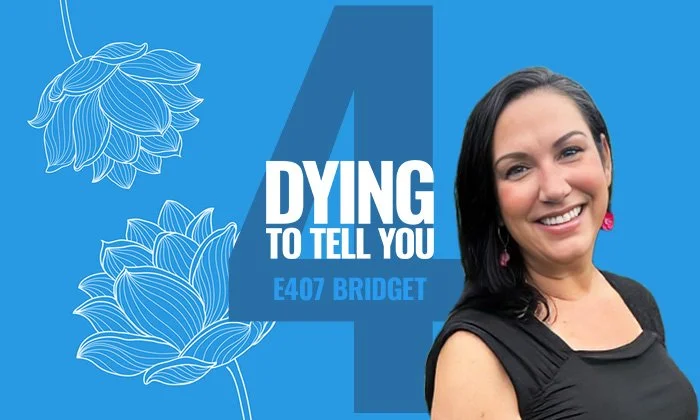
Listen and subscribe on Spotify or Apple Podcasts.
We Talk Living, Not Numbers: Defying the Odds of Stage Four Breast Cancer
Cody: Dying to Tell You is supported by the Iliff School of Theology's Death Care Collective. We'll share more about them and their educational offerings later in the episode.
[MUSIC]
Bridget: First off, we don't talk numbers — we talk living, and you're gonna live. That statement just had such an impact on me. And Dr. Grana said, "But being realistic, I do need you to make sure your affairs are in order — and you do it, and you put it in your nightstand or your office, and you never look at it again."
Cody: In 2017, at the age of 35, Bridget was working as a nurse practitioner, was engaged to be married, and was making plans for the rest of her life.
After a day of hard yard work, she felt a lump on her breast. She didn't think much of it. But Bridget got a mammogram and an ultrasound, and afterward, the radiologist wanted to talk to her — which made Bridget begin to think this might actually be something. He told her he wanted a biopsy, which they did. After reading the biopsy report, Bridget says she realized she was in trouble. She had stage two invasive ductal carcinoma with a BRCA mutation.
Her cancer uses estrogen and progesterone to grow, so she had a bilateral mastectomy and was put on hormone suppression, which put her into menopause until she could have a hysterectomy and oophorectomy in 2019. It took a while to process and adjust to menopause, the medications, the side effects, her new body, the way she felt, and the emotional impact of all she'd gone through — including the dissolution of her engagement. But at the five-year mark, Bridget felt like she was in the clear.
Then, in January of 2024, she was in a bad car accident. She had persistent pain, especially in her shoulder, and noticed a strange divot in her reconstructed breast. In September, she went to her plastic surgeon to have it evaluated. He agreed there was some torn muscle that needed repair, and they scheduled surgery for an implant exchange. During that process, he found a nodule and biopsied it, knowing Bridget's cancer history.
He told her about it, but she'd been so long with no evidence of disease that she assumed it was nothing. Bridget had her first PET scan one day before her surgery, which was scheduled for November 21, 2024. On the day of surgery, she met with her surgeon. She told him she had her PET scan results, and he left the room to look at them. He came back, sat down with her and her mother, and told her what he saw.
The report showed stage four metastatic breast cancer, spread to her liver and her bones. They were shocked. She wouldn't have surgery that day — but her life would change dramatically in that moment.
Cody: This is Dying to Tell You.
—
Bridget: So the surgeon comes in and she's like, "You know, I am Doctor such and such... and...did you see your PET scan, or have you talked to your oncologist?" And I was like, "No."
Cody: Oh no. Did you know then, when she asked that question?
Bridget: No. She gently came over — you know, I'm sitting on the patient table in my pink gown, and, you know, everything's hanging out — and she just gently placed her hand on my lap and brought the report over so we could both view it at the same time. Unfortunately, she'd highlighted a lot of it — the parts she really wanted to make sure were clear. And my report showed stage four metastatic breast cancer with spread to the liver and bones. I just was hysterical. It really knocked the wind out of me. And to this day, I still can't believe I got this diagnosis. But you can't dwell on it. You have to be positive and move forward.
Cody: You can dwell on it. I know people who have.
Bridget: Yeah, it doesn't get you anywhere.
Cody: I want to go back to that moment — you see the PET scan, you see mets to liver and bones. I imagine you knew exactly what that meant. You said it was devastating, but what were you thinking? What was going through your mind when you got that?
Bridget: Yeah, so — being a palliative and hospice nurse practitioner, these are the reports I see from my own patients who aren't doing well. I see twenty-two-year-old patients, thirty-year-old patients. We know the data — cancer numbers are definitely up, especially in the younger population.
All I could think of was my last patient, the same age I was, who passed away from metastatic breast cancer. But I think a lot of my fears were back when I was thirty-five, and I think I have a better appreciation for life now that I'm older, and I know you can't fight fate. So whatever's there, you can — again — kind of choose which path you want to take. I know people typically ask, with stage four metastatic breast cancer, what the overall survival rate is — the numbers, the longevity, the trajectory, the quality of life. A lot of heavy stuff.
Even my oncologist said, being very frank and real: typically, people with your condition, that's what they'll die from — versus, say, me having a stroke at eighty. What's probably going to finalize things for me is the metastatic breast cancer.
I do have a lot of reassurance and faith knowing there are a lot of studies and clinical trials, and that even though I have this stage four metastatic diagnosis — which is considered terminal — the medications available right now have made a tremendous impact on longevity.
I'm actually thankful I'm on a drug — it's kind of an oral chemo regimen, and I also get two injections once a month. The pills are something called Lynparza, which targets the BRCA mutation specifically — the BRCA gene. They didn't have that years ago. Interestingly, I got a few opinions after this diagnosis. There was one option — a mixture that would have been like a Keytruda, or, no — not Keytruda, like a CDK4/6 inhibitor — versus what I'm on, which is a PARP inhibitor. One of the doctors I saw for a second opinion told me that with Lynparza, my overall survival rate — they use that term, "overall survival rate," or "progression-free state," which is kind of where I'm at right now, no new activity — she told me it would be fifteen to twenty-four months at that time.
Cody: Wow.
Bridget: With the medication regimen I'm on right now. I had two opinions saying to do one thing, and two opinions saying to do the Lynparza and the two injections I'm on. So I was kind of torn, but I went with my gut instinct — if it works, it's gonna work, and if not, I know there's another regimen to follow. Even now — they just had one of the biggest conferences for oncology, ASCO — and the amount of literature and data that came out of that. They think they have something that's going to be effective for early pancreatic cancer, which is basically a death sentence right now. So I do have hope.
I'll say the medications I'm on are no walk in the park, unfortunately — so much so that between the medications and the extent of where the cancer's landed... it's in my scapula, sternum, ribs, hip. My lower back has it really bad, down at L3 — that was actually so bad, the chronic back pain, that I had palliative radiation, which helped. But there's nothing they can really do to fix it — what you have is what you have. And that upset me, when the surgeon told me I'm not a surgical candidate — I'm inoperable, incurable. That hit hard. But I think, having my own experience working in palliative care, there's nothing you can do except give it your all, try your hardest, and be that special case — outlive the statistics they have.
Cody: That's a good point — there are statistics, and they'll give you the average. That means some people don't live as long as the average, but it also means some people live longer than that. They're just talking about the average.
Bridget: Yeah. They're not talking about me — I'm above that average.
Cody: Obviously.
Would you talk a little bit about why you're not a surgical candidate? Because I think people — I've had patients' families ask me this — well, why not? It's there, you can get to it, why not just take it out?
Bridget: Yeah, and I had a hard time digesting that too, honestly. Knowing that the breast is where it started — that's the feeder to the ribs, the back, the sternum, the scapula, the liver — I thought, why wouldn't you cut that source off? I really — I cried and cried, I was inconsolable, just because I was in such shock. I felt bad even leaving that waiting room, getting in a packed elevator with everyone looking at me.
But it did take me a while to wrap my head around why they can't just take the main source out. If you go in and do any kind of invasive procedure on the feeder, you can actually spread more of it — they call it "the showering effect." So with metastatic cancer, there typically aren't surgeries used as part of the treatment plan for stage four metastatic breast cancer. So I understand it now. I didn't for a while, but now I get it.
Cody: Yeah, it's just not effective.
Bridget: Yeah…
[MUSIC]
Cody: I want to take just a minute to tell you about a new course starting soon from our sponsor, the Iliff Death Care Collective. It's called Foundations of Death Care, and there are only fifteen spots, so you might want to sign up soon. This is an eight-week online course covering the psychological, spiritual, cultural, and ethical dimensions of death and dying, culminating in a hands-on capstone. If you're a hospice or healthcare professional, educator, chaplain, death doula, or just want to bring death literacy into your work or community, I highly recommend checking it out at iliffdeathcare.com. That's I-L-I-F-F Death Care dot com.
—
Cody: There's this idea of hope. I've seen people, right after the moment you're talking about — someone finds out they have metastatic cancer, that it's not curable, that it's terminal or life-limiting — and they say, "Well, I'm still gonna beat this," or "there's still hope." And that still sends a bad feeling through me, honestly, wherever those feelings live. There is hope. There's always hope. But as the situation changes, the hope changes. You're not hoping to be cured, because that's not on the table — but you can still have hope. It's a matter of figuring out what that hope is. What are you hoping for now? I know you said you want to outlive the statistics.
Bridget: Above average.
Cody: Right — that's already obvious. But what's the hope for you? What else are you hoping for?
Bridget: Yeah — this might be a good place to get into something else really important, being in the situation I'm in, and so many people are in. Going back to my palliative and hospice care experience — I didn't mention this, but I'm not able to work right now because of the toll, the chronic pain, the nausea. It's hard to eat — it depends. This week Frosted Flakes has been my go-to. You've gotta get your calories somewhere, right? I eat like a bird, honestly — I just don't have the appetite. A couple weeks ago it was Raisin Bran. Always a good bowl of cereal.
Back to finding hope — I'm with an oncologist now who's great. I would have stayed with the oncologist I'd had since 2017, at one of the big academic centers, University of Pennsylvania, and I was glad to have been there in the beginning, back in 2017. But with the traffic and the commute, it was a long, stressful day. Being able to get the same level of care here in Jersey, ten minutes from me, with a renowned oncologist — I adore her, Dr. Grana, from MD Anderson Cancer Center at Cooper. She had the same philosophy as my initial oncologist, Dr. Bradbury — turns out they were actually residents together. That gave me a little "ooh, okay, that's great" feeling.
Earlier that same day, I'd been with the doctor who gave me that fifteen-to-twenty-four-month overall survival number. And Dr. Grana said, "I don't know why she told you that." Dr. Grana's been in the field over thirty years, and she said that doctor should never have said that. "First off, we don't talk numbers — we talk living, and you're gonna live." That statement had such an impact on me. I've been doing a lot of public speaking lately, which is crazy — it gives me purpose, being able to share my journey. One thing Dr. Grana also said, during that same appointment, was: "But being realistic, I do need you to make sure your affairs are in order. You do it, you put it in your nightstand or your office, and you never look at it again. But I really need you to focus on what your end-of-life care wishes are — your living will, your code status, how far you'd want resuscitation to go, and so forth." And being familiar with that, because that's exactly what I used to do with my own patients in palliative care and hospice —
It's not sad, honestly. It's the elephant in the room — talking about end-of-life wishes isn't a comfortable dinner table discussion or coffee talk. It's only this comfortable with you, Cody. That sounds cheesy —
Cody: No, seriously.
Bridget: But that was something I was kind of on a mission about. I treated this diagnosis like — alright, I've gotta get everything in order. My next of kin is my mom, and she's seventy-five — I don't want to put too much responsibility on her. I have two brothers. I know what my wishes are. If things aren't going in the right direction, if it's not looking like I'm going to have a good quality of life at whatever point I'm at, then I want to be comfortable — dignity, respect, peace. I think everybody deserves that. Not being able to express your wishes, or not having them laid out — that's not just a cancer thing. Everybody should have that. A lot of people have a living will just because they're going on an airplane without their kids and the grandparents are watching them.
It really has to be a thing, and I don't think it's talked about enough. I've seen the aftermath of not having it — and I know you have too, Cody — because when a patient's at the end of life, the family is on such an emotional roller coaster. One person disagrees with another — "this isn't what she would want." So I have things laid out clear as day. I have my medical power of attorney, my executor, all of it.
Cody: How are you thinking about quality of life, and where you draw the line between fighting for more time versus being comfortable?
Bridget: Yeah — again, never thinking this was going to be my life, being rediagnosed at stage four. I was thinking, yesterday, driving home from the shore — I was at Wildwood, New Jersey, on the boardwalk, and they've got the tarot card readers and the psychics, the crystals — we used to always do that as kids — and I thought, every tarot card and psychic reading I got before the age of thirty-five, I should get a refund. Not even cancer once, let alone twice. And they told me I was going to be successful, going to have a beautiful family — liars, all of them.
So, adjusting to what this new life is — there's that piece of writing, "Welcome to Holland." This isn't the plane I thought I was getting on, or the destination I thought I was going to. But you really just have to try to make your setbacks prosperous, turn discouragement into hope. The mindset I've tried to hold onto is: if it doesn't bring me joy, it's not welcome in my head. I've got enough stress as it is, so I keep that at bay. I have such great resources to help with that — my friends and family, of course, who make me happy. I also listen to my body. The medication can make you really fatigued — that was one of the biggest problems in the beginning, where I'd sleep almost eighteen hours a day for three straight days. They've since lowered the dose a bit, because I had such a good response and was able to push through it that first year. I'm about sixteen months in now — so that fifteen-to-twenty-four-month number...Liar!
Bridget: One of my other good friends, Larry Ansanucci, has this phrase he likes: "Live your dash, right?" We don't know when that final stamp's going on the tombstone, but until then, whatever's going on in my dash, I'm living life to the fullest — getting everything out of it that I deserve, whatever brings me happiness. If it doesn't bring me happiness, I'm not participating.
Cody: Yeah, yeah…
[MUSIC]
Cody: I know you're doing a really good job of living it up.
Bridget: Trying to.
Cody: And I think it's probably more difficult now than it used to be.
Bridget: Life in general, or —
Cody: Yeah — doing the things you really want to do takes more effort now. I imagine you get to a point where you're fed up with it. Has that crossed your mind?
Bridget: Yeah, in a couple different ways. Overall quality of life, as an almost forty-four-year-old — I have my own home, I'm independent, I take care of things, I even enjoy gardening, being outdoors. But there are a lot of things I can't do now, because I'm susceptible to fractures — my bones are pretty compromised from the metastatic disease. That upsets me. But I still do what I can. Even yesterday at the beach, I had my bag and my chair, and my friend Alisa offered to carry it for me, and I was like, no, I'm fine. A lot of people want to help me, but I want to keep doing what I still can.
There are things I can't do — but I'll pull the cancer card. "I got cancer, I'm just gonna call my brother to come do my gutters." One thing that's been really extreme, and I think a lot of people go through this but it's not talked about in the general population, is the financial toll. It's bad.
I recently met with my accountant, who I adore — she was actually a patient of mine back in my urgent care days. I kind of slid it in, like, "you're an accountant, could you do my taxes next year?" She's great. But looking at the projection for the end of the year — what you get paid on disability is pathetic. And believe it or not, I'm actually at the higher end of Social Security disability, just because of all the years I worked and had a decent median salary over the past twenty-some years. Right now we're looking at minus sixty thousand dollars from last year. I'll have an insurance gap between December 31st of 2026 and May of 2027, when I'm finally eligible for Medicare.
The medications I'm on — one shot is eighteen thousand dollars, the oral chemo is seventeen thousand, and the other shot isn't covered by insurance, so I pay two hundred fifty dollars out of pocket for that each month. I'm living within my means, but this was never my means. I worked hard to have the things I have. Being in this financial bind upsets me — I used to love getting silly gifts for the kids, and we just had a bunch of graduation parties, and I wished I could put more in the card, but I can't. That bums me out a little. But I'm making the best of what I can, and getting through.
Cody: The way you're handling this and thinking about it is so —
I don't want to say "healthy," because that's a judgment — but I think you're doing a really good job of accepting all of it. Like you said — Welcome to Holland. You thought you were going to Italy —
Bridget: Nah, more like a third-world country. I definitely left Italy.
Cody: Listen to next week's episode — there's a guest who talks about that a lot.
Producer's note: The episode Cody is referring to is Episode 2 of Season 4, our interview with Jody Gelb, which is available on your feed. It's from July 2026. And back to the show.
Cody: The life you had was way bigger, and I'm just seeing how things have shrunk. You were working, you had more money, you were able to do more things — you were probably cleaning your own gutters. Now there are things you can't do that you used to be able to do, things you can't afford that you used to be able to afford. You don't work anymore, which I'm sure was a source of joy for you. As all of that shrinks — everything that used to be available to you — I think people could see that and feel sad, or you could see it and feel sad. But what I'm seeing instead is that you're looking for the things you can still do, and finding the joy that's there in those things. It's just a good skill to have, whether you're living with illness or not.
Bridget: Yeah. No, and it's a bold statement, but it's the truth. Despite the limitations and restrictions I have, I persevere with what I can, and I have to talk about my friend and family network — how lovely they've been. Even initially, when I was first diagnosed, my childhood best friend got right on it — like sixty text messages across ten different group chats — and collected money for me, and basically freshened up my whole downstairs. Redecorated, new couch, a fresher living space. I was due for an upgrade, honestly, and she took care of it.
I have one of my other dear friends who owns a landscaping company — I'd always used their services, my mom uses them too for cutting the lawn — and I thought, well, I guess I'll start mowing my own lawn now. But she said, "I'm not charging you. I don't want you to ever worry about finances. You're not paying for the season." Back to my power of attorney and executor — they're incredibly giving. They have a second home in Naples, Florida, and they'll often send me down there just to clear my head when I need to — no expenses, just go down and clear your head. They do it out of the kindness of their heart.
Cody: Patients have said things like that — "I didn't know how much people cared," or "I didn't realize how many people loved me the way that they do." It's a shame it sometimes takes being sick to figure that out. But I think the reality is, for a lot of people, there are a lot of people out there who love them.
Bridget: Yeah — people are kind. And as far as any setbacks or financial problems, I know I can go to my family, so I'm not terribly worried about it. It kills me that I'd have to ask for help, because I'm usually so independent. That's one thing that makes me feel guilty — that people are doing this for me.
But another thing I'd like to share — a recruiting agency reached out because they were interested in hearing my story. I've been doing a lot of speaking engagements. I did my first one in February of this year, 2026. I've done a couple of articles, a couple of video interviews with CURE Today. I was also a keynote speaker recently at a gala for a great organization — a nonprofit called Unite for HER — that helps women going through cancer diagnoses with integrative therapies, like acupuncture, meals, that kind of support, so you're never fighting this alone. I also did a speaking engagement for a pharma company. Even these engagements — I'm getting a little bit of money, nothing crazy, but I'll get like five hundred dollars, and that's basically my only paycheck for the month. It's crazy, because I never thought this would be on my roadmap — speaking engagements, not working.
I think my dad would be proud. He passed away in 2004 from a heart attack. He always said I'd be his meteorologist — I always wanted to be on the news. So I think I'm getting my pull, even though I never trained for it — I went the nursing route, and now I'm getting my public speaking fix for fun. It gives me purpose. It really does. Sometimes I can't believe people want to hear me talk again, but honestly, it gives me fulfillment.
Cody: And I can imagine sharing your story with other people gives them hope, too. People tend to feel alone — like they're the only one going through this, and it's hard for others to understand. But hearing someone else's story, hearing hopeful messages about treatment, is powerful.
Bridget: Yeah.
[MUSIC]
Cody: These are just things I ask everybody — do you have thoughts about the afterlife?
Bridget: I do. Of course, I was raised Catholic — I'm still a practicing Catholic. I pray. I pray a lot. That's helped.
Cody: What are you praying for, or about?
Bridget: That's between me and God — I'm just teasing. No, I pray for —
Cody: Okay.
Bridget: No, I'm obviously very open, as you can tell. I say my prayers at night, especially when I can't sleep — I do the repetitive Hail Marys. Right before my PET scans, I pray: please give me the faith and strength to get through these next few days, because there's a lot that goes into those days — even the blood work. Once you get the PET scan, it can take three days to get results. So it's a lot.
It's best to keep yourself busy, obviously. One of my last PET scans, I painted my bathroom — which, I can't paint. What was I thinking? It looks so half-assed. I'm like, well, maybe I'll have my brother come put some crown molding on top, because I missed a lot of ceiling spots. But no — I believe in God. I hope I make my way up to heaven and get to see everyone else who's up there.
Cody: Anybody else up there waiting for you?
Bridget: Too many people, honestly — my dad, of course, my nanny and pop-pop, my grandmom and pop.
Cody: Have you given thought to hospice for yourself, at some point?
Bridget: Yeah, definitely. Because seeing that process versus chest compressions, "let's shock her again," tubes flying everywhere, just laying there — trying this, let's try that, let's put in an EJ line, let's do a central line — no, thank you. So definitely, and I think everyone should really consider hospice. And just because you go on hospice doesn't mean your days are numbered to five or seven — there are people on hospice for eighteen months, because they got a second wind, or maybe they were doing alternative therapy, or they were in a nursing home and now they're in a home setting and more comfortable. Lots of factors go into that. But yeah, I'm a huge advocate for keeping the person comfortable, with dignity and respect.
Cody: Do you have in mind what point that would be, for you?
Bridget: Yeah — having the medical background can be a great thing, or it can be a curse, but being realistic about it — I'm still on my first-line therapy, which is great, because usually around the two-year mark is when the cancer starts saying, "this drug's not working anymore," and it starts spreading more. Then you go to second line, third line, fourth line. I'm in a lot of support groups too — some women go ten years on this. If I'm going to be in pain, and I'm going to suffer, and I'm not going to be able to do the things that bring me joy, then I'm definitely going to transition to focusing on keeping myself comfortable.
Cody: Right. That's something I always ask, partly because you're medical and have that experience — I think it's good for people to hear, one, that it's not "you're going to die in five days." But there does come a point where the quality of your life gets to a place where being comfortable outweighs the need to live longer. And it's different for everybody — different people have different tolerances, different definitions of quality. But giving thought to that ahead of time is really useful. So thanks for entertaining the question.
Bridget: Yeah, yeah.
Cody: Last thing I always ask — how do you want to be remembered?
Bridget: Let's see — I want to be remembered as above average. No, I'm teasing. I want to be remembered as — I hope I was a good daughter, sister, best friend, cousin, coworker, to all my friends. I'm so blessed to have so many different networks of friends that I've maintained, who still continue to reach out to me. I always try to make the best of situations, and I hope people take that away too — there are only certain things you can control in life, and you can't worry about what could, should, or would be. I never thought this would be what my future was going to be, but making those adjustments, always trying to make light of a situation — you know, hakuna matata.
Cody: The theme of your story seems to be, "I never thought this was going to be my life."
Bridget: Yeah.
Cody: But here I am. And maybe it's because we're recording and you're up for this, but you're smiling a lot, and you seem to have a lot of joy. That's a big reason for doing this podcast in the first place — that a diagnosis is not the end of life, and there's a lot to be lived, and you're doing a good job of finding the things that are there for you, even when some of the things you thought would be there for you aren't. There's still plenty. I like that a lot. Good stuff. Thank you very much. When's your next scan?
Bridget: My next scan will be in August.
Cody: Some time.
Bridget: Yeah, cool. So — live in the dash till then, right?
Cody: Yep, that's right. Alright. Well, thank you very much.
Bridget: Thank you. Honest to God, this is great.
Cody: It was a lot of fun.
Bridget: Yeah, appreciate it.
[OUTRO]
Cody: Thank you to Bridget for sharing your story with us, and for continuing to share and advocate for others. If you'd like to see a video of this episode, you can sign up for free at patreon.com/dyingtotellyou. Thank you for listening, for honoring our guests, and for joining me in learning from the experiences of those whose finish line is in sight. This is Dying to Tell You.
