
S4E402 - Transcript
Listen and subscribe on Spotify or Apple Podcasts.
“Crash Landing — One Mother’s Journey Into Grace”
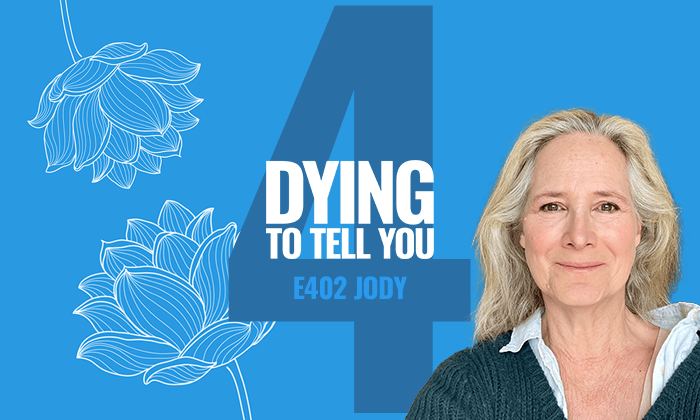
Cody: This week's guest, Jody Gelb, has been a stage actor in New York and San Francisco for over 40 years, and recently wrote a poetic memoir about her life with her daughter Louisa called She May Be Lying Down, But She May Be Very Happy. I first met Jody over Zoom, and the story she told me was devastating, touching, and then heartwarming.
This episode is different from most in that Jody is telling the story on behalf of someone else — her daughter, Louisa.
In 1994, Jody was living in New York with her husband and was pregnant with her first child, Louisa. The catastrophic events of Louisa's birth changed Jody's life. It was the plot twist we talk about so often on this podcast.
There's a wonderful poem by Emily Perl Kingsley called "Welcome to Holland." It's often given to new parents of children with special needs. It describes the beauty that can be found even when reality ends up being completely different than what a new parent has planned or expected — like planning a trip to Italy but winding up in Holland. Jody was given this poem shortly after Louisa's birth, but she recognized that the beginning of her journey with Louisa was less like landing in Holland and more like landing in war-torn Afghanistan.
She wrote: "Holland couldn't be this terrifying. This was a dystopia — birth and near death. Baby rushed into a territory of the hospital with other doomed babies, giant radioactive machines being wheeled around close to babies. Babies who were see-through and not quite finished, eyes taped shut, sporting hand-knit, volunteer-donated wool caps to maintain their body heat. Incomprehensible language being spoken. No guidebooks for Afghanistan. War unending. You could die of exposure in the frozen mountains. A terrorist could blow you up. The only way in was by warplane — or a crash landing."
This week, Jody tells us about the crash landing — but also about leaving the wreckage and finding the gifts that Louisa's life had to offer.
This is Dying to Tell You.
Jody Gelb: My name is Jody Gelb. When I was in one of my very dark, hopeless moods, I called this wonderful woman at New York Hospital. I said, "I'm very overwhelmed. I don't literally know how to function, because something has happened to our baby on the day of her birth. We don't know where we are. I'm very upset," blah, blah, blah. Next thing I know, she faxed me this piece of paper called "Welcome to Holland." It's this wonderful metaphor, designed for parents who are getting some kind of really scary diagnosis for their child. I appreciated those words very much.
As things got scarier for us — Louisa starting to have a new kind of brain seizure, not physically developing the way you're supposed to in terms of rolling, grasping an object, bringing her hands forward, all the babbling things, all the things that weren't happening, the injections my husband had to give her for a month because of this thing called infantile spasms —
If you go to a bookstore, which I did, and you look up infantile spasms in the special needs section, you think you're going to fall over. I don't know the exact percentage, but mostly it's a catastrophic kind of seizure that shows up in infancy, and it usually means terrible things neurologically for the child.
So somewhere along in here I remember thinking — I love "Welcome to Holland." It's great. But I thought, I need to write about this, because Holland is so nice, right? Calm, and all the wonderful things we know about Holland. And where we were was so terrifying that I needed to make up another metaphor that would relate more to what I felt we were going through.
That became the first micro-chapter of what ended up being this tiny memoir I worked on, on and off, for many, many years.
Cody: And what is the metaphor? Where were you?
Jody Gelb: I think because, when this was all going on, one of the most difficult, troubled places in the world at that time was Afghanistan. Our experience was so terrifying — I wanted to create something to describe a different place. So for me it was like a crash landing, not in a beautiful, calm place like Holland, but a place that was very troubled and had been at war for decades. That was my metaphor.
Cody: Yeah.
Jody Gelb: Afghanistan.
Cody: Would you take us back to that day, and what happened that was so traumatic? Let's walk through it a little.
Jody Gelb: I had a wonderful nine-month pregnancy. Then all of a sudden one night I started to get what I knew were the beginning labor pains. We knew we didn't have to rush to the hospital, so we spent the night in our apartment — the contractions would come, but it was early, so we were excited.
In the morning we called the obstetrician to say the baby was probably coming today. It was a Saturday, I think. We went to his office in Manhattan, where I was checked. He said, "You're probably going to get going soon, you don't want this to go on too long, so let's check you into the hospital." We got checked in, and very soon after — that's when they said, "You can't be in labor too long, you'll be too tired, so we're just going to break your water." That's sometimes done for good reasons, I'm sure, but it felt like they were trying to rush the birth, and that was quite painful.
The water broke, and then what I had dreaded — because I'd read about it, and I don't know how I resisted it, but you don't feel like you can in certain situations — they put in the IV and started giving me Pitocin, which works out for most people. Within about three minutes, the contractions were excruciating. Not tolerable. I had always thought I'd have natural labor, like my mother had with my younger sister. But it became like being killed. So I said, "I can't, I need an epidural."
The epidural doctor came in, I got the epidural, and then it's just waiting. They'd come in and out, and at one point they said, "Baby's oxygen is just a little low — not a problem. Lie on your left side, that's better for oxygen." So I'm lying there, waiting. Then the doctor came in and said, very calmly — and I'm glad he said it calmly — "The baby's not happy where she is. We need to get her out right away." I was flipped onto my back. I was experiencing excruciating back labor, where the pressure goes through your back — it's unbearable. You're being told to push, but you can't, because it feels like someone's killing you. So all you're doing is pushing away, because your body doesn't work anymore.
Cody: You're also numb from the mid-back down.
Jody Gelb: Partly numb — but also partly in excruciating pain.
Cody: Right.
Jody Gelb: I didn't see what was going on. My husband said forceps were used and the baby was gotten out. During that time, the NICU team was called, and the emergency doctors were in the room immediately because she wasn't breathing. They had to intubate her — from the records I've since seen, they intubated her down the wrong way first, into her esophagus, then back down the proper way. Then she was whisked away to the NICU. My husband and I were left alone in this hospital room. We didn't know what had happened. Did she die? Is she going to die? Where are we?
Because of the epidural, it was around three in the morning when we were brought to the NICU to see her. She was beautiful — seven pounds, eleven ounces. She was probably pumped full of drugs because her brain had been injured. We didn't know this then, but she'd probably had seizures. I saw her, and then they said they were going to put me on the floor to sleep, and I said, "Just please don't put me near any happy birthing mothers. I can't be around people who are about to be happy."
I had maybe one night in the hospital, and then we were just living this terrifying hospital life — going over every day, spending the day with her. I started pumping breast milk so she wouldn't have to have formula. She was fed through a nasogastric tube into her stomach. I'd sit in a little chair and hold her for most of the day. She was pretty drugged for many days because of the seizures, so it was peaceful — I could just hold her.
But twelve days after her birth, they said, "Now you can go home — the CAT scan didn't find anything." They gave us no information. Just, "Bye-bye." I remember walking out of the hospital with a baby carriage someone had left us, walking into Central Park on one of those incredibly beautiful mid-October days, and feeling like we were escaping the bowels of hell. It's strange to talk about it — it was so terrifying.
Cody: Mm-hmm.
Jody Gelb: Eventually, little by little, I started to see what was going on. "Oh no, she's not developing this way, this isn't working well." But — maybe she'll just have a limp, you know? And I'd remember a little boy I knew who walked to school every morning with cerebral palsy — his legs and arms were affected, but he could walk. So I thought, okay, I can deal with that. She'll have a limp.
And then things weren't going well, and you'd think — well, of course she'll talk. You don't even consider speech. So little by little you get to these points: okay, she'll be in a wheelchair at some point. You think that's as far along as you can get with the hope thing.
And eventually you get to this incredible place, because Louisa was very happy and understood us, and could do a clear yes and no. With time passing, and everything I was looking into, you finally get to: she's happy, we're going to be okay, we're going to figure this out, we're going to find her the right doctors. Can she see? Is she blind? We'll take her to the eye doctor — no, she can see. It was just a long process that first year. At a certain point I got to: okay, we have support, a very special school a friend of mine started. My family was very caring and loving, and we lived there for nine months. Little by little you get to the point of acceptance — oh, I see what happened.
Cody: Mm-hmm.
Jody Gelb: This was catastrophic. She was damaged so severely. But — as my husband said — she may be lying down, but she may be very happy.
Cody: Right.
Jody Gelb: And that's what it was. She was happy. She loved life. And then a little later you get to another place: she's very vulnerable. She got pneumonia when she was two — you don't pay that much attention to a little child getting pneumonia at first, but these things build up to where you realize she's very fragile, and we have to make sure she sees this doctor, that doctor, checking the lungs, all of it.
But we were lucky — we'd meet some mother who'd say, "I know this program for kids with disabilities, run out of someone's living room." We kept magically getting led to the next amazing thing. People had brought special teachers over from Hungary, because they'd invented this amazing way to work with kids with these disabilities, back in the 1940s. We kept getting led, and eventually ended up at this incredible school out here that Neil Young's wife, Peggy, had started in the late eighties. I found out about it by accident — the New York Times had written about the benefit they did every year.
So there I am, down at United Cerebral Palsy, dropping Louisa off for her first preschool, eating a toasted bagel across the street, and somebody had left a piece of the Times on a table. I picked it up, and there's an article about the Bridge School. That afternoon I'm on the phone with their secretary. That was the beginning — sending in reports, and a spot opened up a few years later when she was the right age. We were very lucky we could make that move — leave New York and move here. The Board of Education agreed it was the perfect placement for Louisa.
So we had a lot of — some people call it grace.
Cody: Mm.
Jody Gelb: We had a lot of grace through those years.
Cody: Yeah.
Jody Gelb: That was pretty extraordinary.
Cody: I want to go back to your crash landing there in the hospital, and the lack of information you had. The way I read it in your book, it was little bits of incremental acceptance — partly because there was just no information, and partly because you knew within yourself, "I can't hear the bad things." There's a lot of pressure from people around you, and probably medical professionals, to just get on board, be okay with what's happened, accept it. How did you have the agency within yourself to say, "I can't have that bad news right now. I can't know that right now"? How did you draw that line, that boundary?
Jody Gelb: I think it was gut instinct. I couldn't deal with hearing the bad news. I just needed to live in the hope, for whatever period I needed to live in that hope. And it wasn't only me telling doctors — we were lucky, because I had stories from other parents who had that horrible thing happen, where a doctor out of the blue says, "You should really consider putting your child in an institute," or some casual, devastating comment, like, "Well, don't get them piano lessons." I remember a wife telling me her husband never got over a comment like that.
I hadn't been warned, exactly — I just knew I couldn't deal with anything more than we'd already dealt with. It looked really bad, but I needed to keep hoping things would get better, that she'd be able to do things physically, that she wasn't going to be disabled. And even when I was saying, "maybe she'll have a limp" — little by little, I'd think of Daniel Day-Lewis in My Left Foot — severely disabled by cerebral palsy, but his left foot worked, and he had intelligence. I'd conjure these things and think, okay, I can do this. I used to fantasize about running into Daniel Day-Lewis and telling him how much that movie helped people like me believe they could do this.
So little by little I'd say, okay, I can do this. But there were doctor's appointments where I was so lucky — I'd ask the neurologist, "What's in this MRI?" And at a certain point I think I asked one question.
Cody: Can she be okay?
Jody Gelb: Can she still be okay?
Cody: Yeah.
Jody Gelb: And I'm so lucky, because that neurologist had the awareness to interpret what I was really asking — which was, don't freak this woman out, because if you start talking about the basal ganglia being damaged and what that really means, she's not ready to hear it. I think more doctors are trained that way now. I was just, seat of my pants, instinct — I can't tolerate this, so help me out here — without ever saying it outright, and somehow they heard it.
Cody: Either a wonderful mistake on his part, or wonderful insight.
Jody Gelb: Yeah.
Cody: "Can she still be okay?" — I actually wrote that down as I was reading, because it's such a broad question, open to interpretation. He could have easily said, "What do you mean by that, exactly?" Instead, his answer meant she can live a life that's going to be just fine, with her parents, that she can be okay. It's hard to put into words, because I think the answer to "what does okay mean" probably evolved for you over that first year or two, as you came to accept what her life was really going to look like — but those little pieces of hope along the way are what got you through each particular moment, even when the specific hope didn't come true.
Jody Gelb: Until I could accept the next thing. And then, you know — she's happy, she smiles. After she went through this horrible, month-long course of injections to stop the infantile spasms — and for some reason it worked, they never really know why, sometimes it works, sometimes it doesn't, sometimes the child never stops having seizures for the rest of their life. I think because Louisa's seizures were from the brain damage, once that calmed down, she was stable. Then she started smiling again, after a month of treatment that made her scream and cry for hours at a time, because it's a corticosteroid — it ramps the baby up. The hospital just says, "She might be a little irritable." It was really painful. Her face got swollen from the steroids, we had to test all her fluids — and then she came out of it, and all of a sudden she's smiling.
The neurologist — I think the fourth one we saw, who'd put her on that treatment — said, at one of the checkups, "She has great social skills." That meant she was connected to people, she was right there. From then on you start to see all the good things — she's happy, she's not screaming all the time, and more and more good things presented themselves.
Cody: If you had known, on that first day, what life would look like down the road — I can imagine it would have been completely overwhelming. I can imagine thinking, there's no way I can do this. I'm not one of the strong people.
Jody Gelb: Right. That's exactly why I thought it couldn't happen to me — I had this magical thinking, that it doesn't happen to people like me, that I'm too sensitive, too emotional, not strong, so don't worry, it's not going to happen, because I couldn't take it.
Cody: But apparently that's not how it works.
Jody Gelb: Right.
Cody: You become strong because it happens to you.
Jody Gelb: Yeah.
Cody: Would you take us to the moment your husband said "she may be lying down"? When you told the story before, it sounded like a moment where you were coming to the realization that she was going to spend most of her life lying down —
Jody Gelb: Yeah.
Cody: — and it seemed like it was on the verge of being devastating, until he said what he said.
Jody Gelb: Yeah. We were still living at my parents' that first nine months. She'd have physical therapy in the apartment — an amazing program through New York State. The therapist would come and work with her on the bed, and once in a while she'd mention the word "tone," as in muscle tone. I didn't know what it meant, but I didn't want to know — it sounded like something I didn't want to hear, and it turns out you really don't want to hear that your child has abnormal muscle tone.
So I think it was after one of those sessions — Louisa lying on the bed — I got into that nervous, can't-deal-with-it headspace. My husband was there, and I said, not hysterically, but with an edge to it, "Is she always going to be lying down? Like — lying —" Oh my God. And he just said, very calmly, in his beautiful Polish accent, "She may be lying down, but she may be very happy." It was such a powerful moment for me.
Cody: Mm-hmm.
Jody Gelb: He doesn't even remember saying it, when I asked him years later. But he has so much wisdom, and a calmer personality than mine. That kind of energy — it's okay, she could be very happy — is so soothing and healing.
Cody: Yeah.
Jody Gelb: That was for me another one of those little miracles.
Cody: Magic, for sure. And that's how it turned out — she was very happy.
Jody Gelb: Yep. That's how it turned out. She was very happy. There were certain people she loved, she had a sense of humor — a dark sense of humor, sometimes. Something terrible would happen and she'd laugh about it, where with a typically developing kid you might try to explain why that's not funny. But Louisa's world was different. As my husband also said, way back then — "She's completely normal."
Cody: Mm-hmm.
Jody Gelb: And that's what it was for us, in many ways, because we could ask her questions — do you want this, do you want that, do you want to watch this movie or that movie — and she'd turn her head to the side. That was a yes.
Cody: Mm-hmm.
Jody Gelb: She knew her alphabet, from school and from Sesame Street, so you could go through it — "Is it A? Is it B?" — and she'd stop you at the right letter. Then you'd figure out, oh, she wants this story, or this music, or this movie. She was an amazing child.
Cody: "She's completely normal" is a really beautiful thing to say, and it's so true in so many ways — because she is normal, for her, and that's who she is. We make accommodations for everyone in a lot of ways; she just needed different kinds of accommodations than everybody else. That's a great perspective — and again, one you can only come to when you can come to it.
Jody Gelb: Yeah. But at a certain point, Louisa's health went off the rails. She'd been pretty healthy through most of her life, and then — what happens a lot of times is you become medically fragile, because your muscle tone is everything's out of whack. Your swallowing isn't strong. If you have a weak swallow, you're at risk for aspirating — saliva, food, whatever — and you can get these terrible aspiration pneumonias. We'd seen it happen with a lot of her classmates. We'd seen a bunch of children die very suddenly. So I knew where we were — keeping her healthy. But you also knew, okay, now we're on a downslide here. It's not going to go well. I could see where we were going. They luckily don't tell you that earlier — another thing that was nice not to be told. But if you're paying attention, you see it. A lot of these kids die young, or in their early twenties.
So we did everything we could. She spent a lot of time at the children's hospital down at Stanford, in Palo Alto, an amazing place. That's when I was totally in reality, and I could say to a doctor, "Where are we? Tell me where we are." Doctors knew what I wanted to hear by then, and they were very honest with me. They'd say, "Each plateau, you go down, you don't go back up — this is the way it's going." You just did the best you could. We felt we were getting great medical care there. I'd stay up late at night doing research about death and dying, life expectancy. She died when she was sixteen and a half. And — there you are.
Cody: Yeah.
Jody Gelb: Yeah.
Cody: It's very similar to that kind of trajectory — that plateau, stair-step trajectory — in older people with lung disease, emphysema, COPD. You have an exacerbation, it requires hospitalization, they get you through it, you come back up a little, then ride along to another exacerbation. For you it was these aspiration pneumonias. Can you tell me a little about how you navigated the hospitalizations, and how you balanced prolonging Louisa's life with the quality of her life? Was there a time it became clear she wasn't going to make it through a particular pneumonia or episode?
Jody Gelb: That never quite happened where she was in the hospital, getting worse and worse, and we thought, this is it. There were moments when catastrophes happened in the hospital — everybody rushes in, they call a code blue or a rapid response, and they get her through it. Then more information comes: now we really see what's going on. She needs a trach, which was a very hard thing to get my head around. I called the one mom I knew whose daughter had a trach, and she talked me through it. At a certain point it's not a choice anymore — you have to do this tomorrow, because her little trachea would sometimes just collapse.
So she got the trach, and on we go — learning how to deal with that. She had a lot of continuing illnesses, but it's never like, "Now we're going to stop treatment." It's not like an overwhelming cancer diagnosis, where there's a clear moment for that conversation. It was always — I know where we're going, and we're just going to get the help we can and keep her as safe as we can. We also knew she wasn't going to have a long life. We hoped she'd be with us another four or five years — doctors would say kids like Louisa tend to make it to about twenty-one before their lungs give out. So I thought, great, we've got five years. But nobody can really predict that. There was never a time when I thought we were going to stop treatment. Never — partly because, even though she was in the hospital a lot, she was very happy. She had a big crush on Igor, the respiratory therapist. She loved the hospital — people coming and going, the social scene of it. We don't love the word "fighting" anymore, but we were always trying to get her the best care, to keep her healthy as long as we could. And we knew the reality — we had friends whose children had died in the middle of the night, more than once. We'd seen all of these different things. So we knew what was possible, and we did everything we could to keep her healthy and happy and with us.
Cody: It's okay to say no if you don't want to talk about this — but I'm curious about the end. How did she come to the end of her life? Was it at the hospital, was it home?
Jody Gelb: I had left home two weeks before. I'd taken her to the doctor — she was getting another lung infection, didn't need to be hospitalized, they just put her on a strong antibiotic. I had committed — it sounds crazy, but it made sense at the time — to a six-month tour with the show Wicked. I'd done Wicked in San Francisco, they liked me enough, and offered me the tour. I looked at the schedule — all in the West, with three days off between cities every few weeks, so I knew I'd be coming home regularly. My husband and I figured, six months, we'll make it work.
So I left in mid-March, went down to Costa Mesa in Southern California to start the tour. That weekend, I was talking to Louisa and her caregiver over Skype. She didn't look well, didn't feel well, something was going on. My husband was talking to the hospital and the doctors, and they said, "Don't bring her into the hospital right now — a lot of kids are very sick right now, and she's too vulnerable. She'll see her gastroenterologist and pulmonologist first thing Monday morning." That was all on Sunday. Something happened in the middle of the night — we don't know exactly what. Did her body go into sepsis? We don't know.
Cody: Mm-hmm.
Jody Gelb: But for some reason, it was too much. I got the call in a hotel room in Costa Mesa, from my husband. It was terrible.
Cody: Yeah.
Jody Gelb: And of course — how could I not have been there? But I wasn't. I was going to drive home that Monday; I'd finished in Costa Mesa Sunday night, and was getting in my car Monday morning, a five-or-six-hour drive. He called me probably at seven in the morning.
It's shocking, of course. I literally just held the phone — it was almost a conscious decision — I shrieked as loud as I could, twice, and then called the front desk and said someone needed to come to the room, something terrible had happened. These poor young people from the hotel desk came up, and I told them what had happened. I was in shock, or whatever you call it — not crying, not screaming, I just needed somebody in the room. Then I thought, I have to get home — how is that going to happen? I couldn't think straight, and then it popped into my head: call your stage manager. Stage managers are the most amazing people in theater. He came right over and said, "Don't worry about anything — I'll drive your car to the next city, I'll get you to your flight." He made everything happen. I was home within a few hours.
Cody: Wow.
Jody Gelb: It's still hard to believe we all went through what we went through, and we miss Louisa all the time. It's strange that it happened, that we lost her, and that we had this great life with her. There's something — even with typically developing children, there's a point where you don't need to mother them anymore, because they're out of the house, and there's a little grief around that too. So it's a more complicated grief. I'm totally fine, honestly. This happened in 2011 — I consider myself an elder griever now. I can be there for other people. And then there are times when some piece of music will come on, and I'll either turn it off, or think, you know what, I'm having a real emotion, I'm going to play this and let myself cry and scream, and it'll be over in three minutes. But mostly, like right now, I can just talk about Louisa.
Cody: Yeah.
Jody Gelb: That's how it is now.
Cody: Back to the metaphor of the crash landing in Afghanistan — it sounds so true in so many ways. This traumatic entry into a place with a strange language, where you don't know where you're going or what you're doing, and then you live with it, and start to grasp what's happening, who's with you, what's possible. And eventually you start to see the beauty in things, even in the midst of chaos and difficulty.
Jody Gelb: You realize there are all these other people there. I had another metaphor too — like you're in a terrifying, dark forest. In the beginning you're terrified, you can't move. And little by little, the light starts to change — your eyes get accustomed to the dark, something like that.
Cody: Mm-hmm.
Jody Gelb: And you realize you're surrounded by all these families. They're all there, and they become a family of yours. They have special kids, kids who went through catastrophes, who were injured, who died. There's a worldwide community of people who are there for you, and you for them. You have a bond. In my old life, I would have thought, oh, I won't even look at a child in a wheelchair. Now I see a family with a kid in a wheelchair, and I'm very respectful — I've had incredible conversations with people on the street, just to say hello. I don't even go into my backstory, I just say, "I've got a lot of people in this world," and it's so nice to meet you. It opens up your world in a way you never wanted to know about. But your heart, if you're lucky, really opens, in a very beautiful way.
Cody: There is something about going through this particular kind of trauma — maybe any kind — that turns you into an amazingly generous person.
Jody Gelb: Right. If you're lucky, your heart doesn't harden, it somehow opens — because we're also vulnerable in our own little human lives. We all face so much. Maybe not this, exactly, but we're all facing something, and it can be a very positive opening for a person.
Cody: You're making me tear up.
Jody Gelb: That's healthy.
Cody: It's true in so many instances — any kind of difficulty we face, we have this choice, this opportunity, to either harden our hearts —
Jody Gelb: Yeah.
Cody: — close up, become defensive, or open up and become generous and kind, open to new things. It's very meaningful. Very powerful.
Jody Gelb: Yeah.
Cody: I'm so glad that you opened up. I'm so glad all of this turned you into this person, rather than what it could have been — a very hardened person. It could easily go that way for a lot of people.
Jody Gelb: We were lucky. We had so much family support.
Cody: Yeah.
Jody Gelb: I have friends who went through the tortures of the damned in a fifth-floor walkup in New York with no help — no family. They went through the seizures, the shots, all of it, completely alone.
Cody: Yeah.
Jody Gelb: We were living at my parents' for nine months, and they never once asked, "How long are you staying?" We just moved in.
Cody: Hmm.
Jody Gelb: Then about nine months later, we moved out. I was very lucky.
Cody: Yeah.
Jody Gelb: Very lucky.
Cody: What would you say is the overall lesson you carry with you from this experience?
Jody Gelb: Hmm. I don't know that I've ever articulated it so clearly, but — there's something about the overwhelming feeling of love and care, being able to take care of this amazing, beautiful daughter. You can survive more than you think. You can go on — life will go on. The connections with people, that was very powerful — realizing we weren't alone. We were so lucky, supported emotionally by so many people: my husband, my parents, Mary Jo at New York Hospital who set us up with that program, the therapists, this incredible web of support, out into the doctors. But yeah, I have to remember a huge amount of — I think the word is grace. Things just happened, and we were not alone.
Cody: Yeah.
Jody Gelb: And then I had my second daughter, my beautiful second daughter. Pretty lucky.
Cody: It's a beautiful story. It's a lovely book — I'm taken with your writing, I really like the way you write. It does the story justice, I think.
Jody Gelb: Thank you.
Cody: There are a couple of things we typically ask people living with illness — I'm going to reframe them a little for you. This is how we wrap up every interview. First, we always ask about people's thoughts on the afterlife — whether it matters to you or not, whether you have a religious or worldview take on it.
Jody Gelb: I'm just floating around, not knowing — that's what I can say. It's interesting — I'm finishing up an amazing class this week, in the grief space. There's this wonderful man who's been in that world for decades, David Kessler. People I knew through this world kept mentioning, "Oh, I've done the Kessler grief educator training." I finally asked what that was — it's a three-month training I'm finishing this week. In one of our last classes, he talked about culture and religion, and about working with people in grief.
I'm not a therapist, and I'm not going to be one, but I wanted the training because I'm sometimes in a grief support group for parents like me. He said — and I was surprised, because a lot of people are so cold to this — he's done a book and research about what he calls near-death visits, where they've studied people over and over, and he's talked to medical professionals, not just the families, because if it's just families, he said, no one will believe you. But medical professionals who are in the room, and the dying person, very often, sees their mother, or some loving family member who has passed.
Cody: Mm-hmm.
Jody Gelb: I just loved hearing that. I've heard it many times before, too. So — where am I? I'm very open to it, of course wanting it to be true with Louisa. It took me a long time — maybe a year — before I ever dreamed of her.
Cody: Hmm.
Jody Gelb: I finally had a dream of her when I was alone one night in Arizona. It was the happiest dream — she was being held in someone's arms, and I was overjoyed to see her. It turned out it was her birthday, October 2nd, in the middle of the night, when I had that dream. I woke up so overjoyed. No sadness that it had only been a dream — just full of joy and love at having, quote, "seen" my daughter. I don't know what it all means. I just never wake up sad if I see her in my dreams.
Cody: Yeah.
Jody Gelb: I wake up overjoyed. So — what are my beliefs? I don't know. But I'm tired of sitting somewhere agnostic — half Jewish, half Episcopalian, nothing. I'm actually going through something right now where I can't tell you exactly what my beliefs are, but I'm becoming Catholic.
Cody: Okay.
Jody Gelb: Some friends say, "Oh, really?" Others say, "Oh, that totally makes sense." I can't really explain it, but for many, many decades there have been things — why do I always want to step into a Catholic church when I'm somewhere? Why do I want to go in and light candles? I finally had this moment last spring where I thought, you know what — I just want to go through this. It's a nine-month program.
Cody: Yeah.
Jody Gelb: I go to my little church and my OCIA group, and on the Easter Vigil, April 4th — which is the anniversary of my daughter's death, an amazing coincidence — I'll be confirmed into the Catholic Church. Some people, when you tell them that, just don't like it at all, and I understand. But at this point in my life, I want to see what's there for me, and to try to pray for some kind of faith, basically. I really don't know — but I don't want to just stay where I was. I want to learn about this now.
Cody: Mm-hmm. I like that. The last question we ask everybody is how they want to be remembered. So I'm going to ask you — how do you remember Louisa?
Jody Gelb: I remember Louisa with so much love and joy. I remember her at three in the morning, in the emergency room for another bad illness — I'm full of fear, and I look over at her on her little gurney, and she's smiling ear to ear. I follow her eyes — what's she looking at? There's a handsome male nurse doing something with her, and she's just full of joy and happiness, because —
Cody: Mm-hmm.
Jody Gelb: — she's in the moment. There's this lovely young man taking care of her, and that little example is a big part of how she carried us through — it's going to be okay, we're going to be okay, because Louisa's happy, and Louisa loves life. Once in a while something creepy in a movie would scare her, but mostly she was very, very happy, and loved life. That's how we lived with her, and that's how I'll always remember her. Thank you for asking that.
Cody: Yeah. May we all be so lucky —
Jody Gelb: Yeah.
Cody: — to live in the moment, and not in fear.
Jody Gelb: Yeah.
Cody: When things like that happen — look for the handsome male nurse.
Jody Gelb: Look for the male nurse.
Cody: I know.
Jody Gelb: Yeah.
Cody: Goodness — what a gift. Well, Jody, thank you so much. Tell us the name of your book, and do you have a website?
Jody Gelb: My book is, as we said, She May Be Lying Down, But She May Be Very Happy. It's published by Kelsay Books, up in the Northwest, and I have an author website — just my name, jodygelb.com.
Cody: We'll put a link in the show notes so people can find it.
Jody Gelb: Great.
Cody: Thank you so much.
Jody Gelb: Thank you, Cody, for having me on the show. This was really great, really enjoyable.
Cody: Thank you. I've loved it.
Cody: Thank you, Jody, for sharing your story, and for sharing Louisa with us. I highly recommend Jody's book, She May Be Lying Down, But She May Be Very Happy. It's a memoir, but written in a very poetic way that invites the reader to feel the emotions Jody is expressing. You can find more about Jody, and order her book, at jodygelb.com. That's J-O-D-Y-G-E-L-B dot com.
If you'd like to see some video or extra content from this interview, you can do that at patreon.com/dyingtotellyou. You can sign up for free to see more from this interview, stay up to date with callback episodes with past guests, behind-the-scenes videos of interviews, and more. That's patreon.com/dyingtotellyou.
Viktor Frankl said, "Everything can be taken from a person but one thing: the last of the human freedoms — to choose one's attitude in any given set of circumstances, to choose one's own way." In the midst of everything happening, remember — we have the opportunity to choose how we respond. May we all choose an attitude of kindness, to others and to ourselves.
This is Dying to Tell You.
