
S4E401 - Transcript
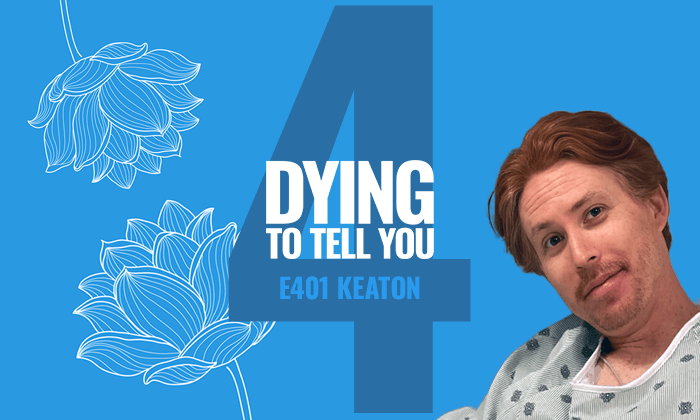
Listen and subscribe on Spotify or Apple Podcasts.
“One of One — Advocating for Your Life in a System Built for Many”
Cody (Host): Hi, welcome to season four of Dying to Tell You. My name is Cody Hufstedler, and I'm the host of the podcast. I'm a palliative care chaplain, and I worked on an inpatient palliative care team for over a decade in Denver, Colorado. I started Dying to Tell You hoping to allow listeners to have a look into the kinds of conversations I was having with patients who were facing their own mortality.
If this is your first time listening, welcome. I hope you have as much fun and learn as much from these amazing guests as I have.
—
Our first guest this season is Keaton. Keaton was thirty-five years old at the time I recorded this interview. He lives in Denver, Colorado, with his wife and two-and-a-half-year-old son. He describes himself as an average guy, although I think you'll see this isn't quite true. He likes cooking and woodworking and spending time with his family.
In early 2025, he was living his life. Looking back, Keaton can see there were some things happening with his body that might have given him a clue something was wrong, but they were minor enough that he didn't think anything of it. Then one weekend, he had some minor stomach pains below his ribs, where his liver was.
He said the pain was about a two out of ten in severity, but it didn't go away, and something told him he needed to get it checked out. After googling, of course, he thought he might have a gallbladder infection, so he drove himself to the hospital emergency department hoping to get an ultrasound, as Dr. Google suggested.
In the ED, they did some blood work and an ultrasound. The blood work was normal, but the ultrasound showed several large masses on his liver — one eleven centimeters and one five centimeters, the size of a grapefruit and a lime. They wanted to do a CT scan, so he waited. With that limited information, Keaton spent twenty or thirty minutes staring at the wall, vacillating between believing his body was riddled with cancer and hoping the masses were benign.
He had the CT scan, and as far as they could tell, the cancer was confined to his liver. They kept him in the hospital overnight for a biopsy, and he went home the next day to wait for results. Four days later, on March 18, 2025, Keaton was diagnosed with intrahepatic cholangiocarcinoma.
Intrahepatic cholangiocarcinoma is a rare, aggressive cancer. It originates in the bile ducts inside the liver. The five-year survival rate is nine percent. That's low. But for Keaton, this is complicated, because it's rare for someone so young to get this diagnosis — the average age at diagnosis is seventy. It's also rare to catch this cancer early. Often there are very few symptoms, and there aren't regular screenings for it like there are for other cancers. But Keaton listened to his body, and found the cancer before it spread outside the liver.
So Keaton's story is unique. This is Dying to Tell You.
Keaton: I'm Keaton. I'm thirty-five now. I'm a husband and father to a two-and-a-half-year-old son. I'm, I think, a pretty average guy from Colorado.
I had made a point early on to tell doctors specifically, "I don't want to hear how long you think I have to live. I don't want a number," whatever — because that's not me.
And I told him that, and he said, "Don't worry about that. You're gonna live a long time on treatment." And I said, "What was that last bit again?" He said, "Yeah, you're gonna live a long time on treatment." And I said, "Oh — I mean, it kinda sounds like I'm gonna be on treatment for the rest of my life." And he was like, "Yeah. I mean, yeah, you... yeah."
That was the first time somebody had told me, you know, that the rest of my life... It was that moment when "incurable, inoperable, unresectable" — I'd heard those words before, but that was the moment they started to sink in.
Cody: Hmm.
Keaton: It was like, "Okay, the rest of my life is going to be cancer treatment." And it was also the moment I had this realization — "Okay, I feel pretty good right now. I'm not in pain. I'm not jaundiced. My body's still working, for the most part." And I just started thinking, how long is that gonna last?
Cody: Right.
Keaton: Is it all downhill from here, basically? Is this as good as I'm gonna feel for the rest of my life? Because I was about to start chemo, and I'd heard stories about people going through chemo, all the side effects, and it's just not a fun experience. I'd heard all these things, and I was like — I'm not gonna feel good on chemo, and then what happens after that is just the rest of my life. It's a hard thing to wrap your head around. Definitely not something I was prepared to deal with.
Cody: Hmm.
Keaton: But that's the thing about life, man — I'm not prepared for any of this. This is my first time doing any of this.
Cody: Yeah, first time having cancer.
Keaton: First time having cancer. First time being this age. First time being a dad.
Cody: Yeah.
Keaton: And I feel like I should remind myself of that more often, because I feel like I should have it all figured out. I'm thirty-five — I shouldn't, I shouldn't have all the answers, and I just don't. And that's totally normal.
Cody: No, it's great. I mean — I'm forty-six. I've got about a decade on you, and I also don't have all the answers, and this is still my first time, too. Whenever I get sick, whatever that might be, it'll be my first time doing it as well. You shouldn't have all the answers, but it's one of those things where you feel like you should have it all together — and maybe you shouldn't have big emotional reactions about it. I don't know if that was the case for you, but I think a lot of people feel like, "Oh, it shouldn't be that for me. It shouldn't be me. Everybody else has that sadness or fear, but I shouldn't be like that." But that's just not the case.
So — you'd heard from other oncologists words like incurable or inoperable, but the doctor in New York basically saying you're gonna be on cancer treatment for the rest of your life hit different than any of those other conversations.
Keaton: Yeah.
Cody: Fear?
Keaton: A hundred percent, yeah. A lot of fear. I find that when I don't have the answers to something, my brain likes to make up what those answers are. And so when I hear "cancer treatment for the rest of your life," I don't know exactly what that looks like.
Cody: So what were you making up?
Keaton: I'm picturing me being sick, being tired, not having the energy to do things I enjoy, not being able to be present in my life and with my son because I feel sick. That's sort of how I pictured the rest of my life at that point, and I was definitely not ready for my life to look like that.
So there was a lot of fear. A lot of anger.
Cody: Hmm.
Keaton: A lot of, "Why is this happening to me? What did I do to deserve this?" And also anger because — what did my son do to deserve this? What did my wife do to deserve this?
Cody: Right. Yeah, it's not only affecting you.
Keaton: And I still don't have answers to those questions, and I don't think there are answers. I don't think I did anything, I don't think there's anything I could have done differently to avoid this. I think it's just one of those things — I got very unlucky in some ways, but I also think, in a lot of ways, I got very lucky, and I still am very lucky. For whatever reason, I decided to go to the ER that day, and they found these tumors, and that's shitty and that's unlucky. But then I think about everything that's happened since — finding out I have a genetic mutation that's targetable, being possibly eligible for transplant now, almost a year later. You can only view those things as... I don't know if "lucky" is even the right word, but —
Cody: Fortunate.
Keaton: Yeah. Yeah. But there was a lot of fear after hearing that, and a lot of anger.
Cody: Yeah. Sadness?
Keaton: Yeah. And grief — but I didn't really understand what I was grieving. I hear people talk a lot about grieving your old self, before cancer, and I think about that and I'm like — I don't know if I really even knew who my old self was, fully. I think I was still figuring that out. I think I was still in the process of becoming who I'm supposed to be. I was stepping into being a dad, stepping into being a husband — this new chapter of my life, with all the uncertainties that come with that. And now I've got this thing thrown at me too. So there was definitely grief of the pre-cancer life, but if we talk about "I was this person before, and I'm this person now" — I don't have a great answer for who that person before even was.
Cody: Mm-hmm. I've heard people talk about grieving the life they thought they were going to have. You have this story in your head about being a dad, being a husband, how that life is gonna play out — and then this diagnosis happens, and that's a plot twist you weren't expecting. The whole story changes at that point. Having to let go of all of that — whatever you had in mind — I think a lot of people grieve that, probably without even being able to put words to it.
Keaton: For sure.
[Music interlude]
Cody: So how did it play out? I mean, you're here.
Keaton: We met with a specialist in New York. At the time we were scared. I had no idea what to do. I was googling a lot, and there are very scary numbers and statistics on Google, and I was kind of freaking out. He said, "Whoever's the most experienced — I'm going to that person." So within a few weeks after my diagnosis, we were packing up our house and moved temporarily to Connecticut so I could start treatment at Sloan Kettering.
Cody: Did you have any temptation to just go, "Maybe I shouldn't start cancer treatment right now because I feel fine, and as soon as I start treatment, I'm gonna feel like shit"?
Keaton: I don't think that ever came up for me.
Cody: Okay. Because — that's all I was just sitting here thinking. "Man, it would be hard for me — I know this is happening, but I don't feel it happening, and I'm about to walk myself into treatment that's gonna make me feel terrible, and this guy just told me I'm gonna be on it for the rest of my life. Ew." But it didn't cross your mind, huh?
Keaton: It actually didn't, and now that you're mentioning it, I'm like, how did I not think of that? But I think it was just one of those things where everything's moving so fast, my head's spinning, I'm getting information from all these different people, and everybody's saying you have to start treatment right away. Because one of the first things if you Google cholangiocarcinoma is that it's a rare, aggressive cancer — those two words are repeated often. So the idea of not being on treatment was a little bit concerning.
I wanted to start immediately because I was also reading a lot of personal accounts on Facebook — there's a cholangiocarcinoma patients Facebook group, and I'd read what other people were doing, what worked, what hadn't. There was sort of this common theme where people would start treatment, things would get better, maybe they'd be able to stop for a while, and then things would come back. So I was hoping that's what would happen for me — start treatment, shrink these tumors a little, get a little better for a while. Not really a cure, but maybe buy some time. So I said, let's do it.
We moved, found a place in Connecticut — actually my parents moved with us, which was very helpful, especially with our kid. But that period of time was pretty difficult for me. There wasn't a lot of hope during that time. I became progressively more irritated by my oncologist and the way things were going. Little thing after little thing that all add up and lead you to believe that someone doesn't really care about what's going on with you. And that's okay — you don't have to care about what's going on with me, but if you're gonna be my doctor, I want you to care. I don't want you standing up and walking out of the room when it's time for me to ask questions. Little things like that.
Cody: Yeah. I mean, it's a little thing, but it's not that little. That's attention.
Keaton: No, you're right. I think I tell myself it's little because I don't want to be high maintenance about it.
Cody: You high-maintenance cancer people. But it doesn't seem that little. It's not little.
Keaton: Like — basic human decency, you know? Is that so much to ask for?
Cody: I don't think it's a lot to ask, honestly. How was the treatment itself?
Keaton: My experience with chemo is pretty typical to what you hear most people talk about. I was nauseous, I felt tired a lot. It's such a hard thing to describe because it's unlike anything I've ever felt before. There were some days I couldn't even hold my son. The most physical activity I could do was standing in the kitchen stirring a pot of soup. And there were other days I'd go out and take a walk on the beach, and it'd be nice. It went back and forth — you get into these patterns where, okay, the first couple days after treatment I'll be tired, then I'll start to pick back up.
For me, during that time, I really leaned into nutrition and juicing. I have no scientific evidence to back this up, but I think that helped a lot with the side effects — the nausea, the fatigue. Replacing the nutrients chemo kills, giving your body what it needs to heal and recover. And for me, it's something I can control. I felt so out of control during those first few months, and it became a comforting thing — everything is out of control, but at least I can control what I eat and what I put in my body.
That period was also when I was trying to learn as much as I possibly could about this cancer, about my diagnosis, about whether there was any way to survive and what that would look like.
It was a hard period for my son, I think. Hard for my wife too — I know it was, we've talked a lot about this. I was going through treatment, and she had to be solo parent. My parents were there to help, but a lot of the parenting fell to her. It's a lot.
So I was in Connecticut for three months doing chemotherapy and immunotherapy, and I got a scan after those three months that showed progression. That was a very scary period — maybe worse than the initial diagnosis.
Cody: Tell me why.
Keaton: I think it was harder because I was doing everything I knew, everything in my power, trying everything. And to get a scan like that — it's like, "Hey, all this stuff you're doing, all this effort you're putting into staying alive doesn't matter. You're gonna be one of those guys that doesn't respond to treatment and is dead very quickly."
I remember riding the train back from that appointment, just talking to my wife about — you gotta make sure my son remembers me. You gotta make sure he knows who I am. Because he's two and a half — if anything were to happen to me, he probably wouldn't remember a whole lot. And I think that's the scariest thing for me — my son growing up with no memory of me, no relationship with me. That's the hardest part of all of this. But it's also my reason for fighting so hard to survive, because he doesn't deserve that. So I'm still trying to do whatever I can to stay around for him.
I ended up getting connected with a mentor through the Cholangiocarcinoma Foundation — a guy who had a liver transplant and is alive five years later. I was like, that's what I want to do. That's my goal. That's my North Star.
Cody: Did you ever mention that to your oncologist at Sloan Kettering?
Keaton: I did, actually. I said, "I think liver transplant might be my best option," and I was told, basically, "We're not there yet."
Cody: Okay. How did you get to further exploring that — what were your steps?
Keaton: I first had to find a place that would do it. Mass General in Boston does transplants for cholangiocarcinoma, so I went there and met with a doctor who outlined the criteria — my tumors would have to be three centimeters or smaller, and at that point they were eleven centimeters. And no spread outside the liver, the disease would have to be stable for six months. I heard that criteria and thought, okay, that seems like a goal that might be unachievable for me — six months of stability with cholangiocarcinoma is —
Cody: That's a lot. Yeah, it's a lot for most cancers.
Keaton: Yeah. And I was like, okay, I don't know if I'm gonna get there, but I'm gonna try. We talked to a few other doctors, and I think it was that doctor at Mass General who told us about Houston Methodist — their transplant program is trying to push the boundaries for cholangiocarcinoma, and they have more relaxed requirements. Still needed no spread outside the liver, and they like to see six months of control before transplant, which makes sense — if there's cancer somewhere else in the body and it comes back after transplant, that's not good.
That's kind of what led us to Houston Methodist, and my team at MD Anderson meets regularly with the transplant team there — MD Anderson refers people to Houston Methodist for transplant. That worked out for me, because my next oncologist ended up being at MD Anderson, and he was the only one willing to fight for me with this drug.
At that point I looked back at my genetic testing, and that's when I found this NRG1 fusion mutation — present in about one percent of tumors, and I happen to have it. There's a drug approved in 2023 that targets this mutation. In those few weeks after the scan that showed progression, I met with five or six different oncologists. Each one recommended second-line chemotherapies, and we talked about clinical trials and the hepatic artery infusion pump — a hockey-puck-sized device implanted in your stomach that pumps chemo directly through the hepatic artery into your liver. All of these things just didn't sound fun to me. I'd heard second-line chemos like FOLFOX and FOLFIRI were not fun.
Cody: Well, they're second-line for a reason. They're not the most effective.
Keaton: Yeah. More side effects — nausea, fatigue, all that. Every oncologist I met with, I'd bring up this NRG1 fusion and say, "We found out there's a drug that might treat this — is that an option for me?" And most people were like, "Nah, that's not an option," or "Let's keep it in the back pocket, it might be an issue with insurance," and that wasn't a good enough answer for me. I was like, "Look, I'm trying to stay alive, and I want to do whatever it takes. If this option could be more effective than chemo with fewer side effects and better quality of life, I want to push for it. I don't care about insurance. I don't care if I'm your first patient who's ever tried this drug. I don't care about any of that. I'm gonna do it because I'm trying to stay alive."
A lot of oncologists were like, "Let's wait and see, let's try these other things first." And I said, "No, that's not good enough." My doctor at MD Anderson was the only one who said, "Yeah, okay — let's try it. I'm willing to fight insurance with you." And he was. It turned out to be a big fight with insurance. But I'm glad I pushed for that. That's one of the most important things I've learned over the past — it's been almost a year now — I might be onto something with my own gut instincts.
I'm not right all the time, but a lot of times in the past I'd have these gut instincts about something and I'd find a way to convince myself that whatever's happening isn't actually happening the way I'm seeing it. I think I'd gotten really good at gaslighting myself — "No, no, whatever you're feeling, it's not all that bad." And I did that with this oncologist. "It's my first time, I don't know anything, he's not that bad." I had weird vibes about him from day one, from our initial meeting, and I ignored them. I wrote off some of my symptoms early on too. After fighting for this drug and seeing it work for me, it made me feel a lot more confident trusting my own gut.
Cody: Yeah. It's not just like trusting your instincts about whether a chemo's gonna be effective — that's not it. You know yourself, right? You know who you're gonna jive with and who you're not. It's hard to know sometimes, though.
Keaton: Yeah. And it's something I never really had to think about before cancer. You hear people say "advocate for yourself," that's important, but nobody talks about what that actually looks like. I think it means putting your foot down and saying, "No, I'm not doing this procedure, I think we should do this instead." But another huge part of it that people don't talk about is being the squeaky wheel that gets the grease — calling insurance five times a day, waiting on hold, calling the doctor's and nurse's office, making sure papers get pushed from one desk to another. There's been a lot of times I'm waiting to schedule an appointment, and they say, "We'll get back to you in a week," and I'm like, "No — I'm gonna call you back at 3pm today, and we'll see if there's any update. Then I'm gonna call you at 9am tomorrow, and 3pm tomorrow..." Not in like a weird aggressive way, but —
Cody: No, yeah, yeah. I don't want to throw medical professionals under the bus. One thing that became really clear to me when I was working in the hospital is — for the doctors, you're one of a hundred. For you, you're one of one. You don't care about all the other people in the hospital the way you care about — well, you care, I'm sure, in a way, but this is your life. And for them, this is their job, and most medical professionals are there because they care and want to make a difference. And still, even with that being true, it's hard to care in the same way someone cares about their own life, because you're one of one to yourself. And I've had family members say, "This doctor doesn't get it." Like — I know there's a lot of other people, I don't care. I care about my dad, and I want to know you're taking care of him. It's hard to elicit that kind of care from people when it's not your own family or close friends. Showing that you care, I think, helps bring that to the forefront — it can get irritating for staff, maybe, but I think most people see it as a need they want to meet.
Keaton: Yeah. My experience has been that ninety-nine percent of people in the medical field are great, and just like you said, they're in it because they want to help people. But it's also a job, and things fall through the cracks — they forget about stuff, just like I forget about stuff at my job. The difference is, for me it's an email, and for them, I could die. The stakes are a little higher.
Cody: They are. But for medical professionals, the stakes are higher, yet it becomes so commonplace and typical that it doesn't feel that way.
Keaton: That's true. So the system is messed up, but when you talk to a person one-on-one, they care. They want to help.
That's where we're at now — we're waiting on insurance, and then I'm hoping to hit the ground running with transplant stuff. Feeling a little weird because my last scan, just this past week, the results were strange — my biggest tumor is still shrinking, other tumors stable, but there were these little ones that were five millimeters and now they're eight millimeters. And I don't understand why that happened, and it's got me again filling in the gaps my brain doesn't have information for. Is it not working anymore? Are they gonna say it's not stable, no transplant for you? Is it gonna stop responding to this treatment and spread, and take transplant off the table? I'm still processing that. Every day is about fifty-fifty — going back and forth between "things are gonna be okay" and "things are not gonna be okay at all." That's crazy. I don't think people talk about that enough — the stress that puts on your mind and body, the exhaustion of month after month, hour by hour, shifting between "I'm gonna die" and "I'm gonna be okay."
Cody: How do you deal with it?
Keaton: I don't know if I have a great answer. What I do is try to keep myself busy, stay as active as I can. Video games help sometimes. Getting outside, doing hikes — it's all helpful. But I find I keep myself so busy with these things that they almost distract me from thinking about cancer. And it works — I'll go for a hike and not think about cancer for six or eight hours. And then there'll be a quiet moment — I'll be in the beans aisle at the grocery store, and it'll hit me, and it all comes up. It's weird how that happens. And then I think, "Hey, am I not processing this the way I should be?" And — that's kind of bullshit. I don't think there's a right way to process anything. It's like those quiet moments, usually at night, when the brain gets a second to calm down — that's when it's like, "Hey, you haven't thought about all this stuff today. Here it is. Deal with it now." And you're like, "Okay, well, I wasn't ready for that, but —"
Cody: "I was planning to sleep, but —"
Keaton: Yeah, exactly.
Cody: "I'll just ruminate."
Keaton: Yeah.
Cody: Well, today — where are you? What do you think?
Keaton: Today I'm somewhere in the middle. I went to soccer practice with my son this morning — he's two and a half, so it's really just running around, soccer balls, playing games. And it's weird doing that kind of stuff. It reminded me of a time we were in Connecticut and I was feeling really sick. They were going to a gymnastics class, and I wanted to go with them — I'd never been to a gymnastics class with them. And here I am thinking I'm not gonna feel well enough to do anything for the rest of my life, and I push myself to go. It was a typical thing — other kids, other parents — and I couldn't help thinking about how none of these other people were worried about whether their kid was gonna grow up without them. It wasn't even anger, it just made me deeply sad, seeing my kid running around and thinking about what his life might be like.
Doing stuff like that with him today brings that up again. Things trigger other things — memories. That's a memory that gets triggered every time we go to soccer practice, and that memory of having to go into the bathroom and cry a little. So I'm in a bit of a better place today, but it still brings up that stuff. We have one of those digital picture frames that cycles through pictures, and one came up from when we were in Connecticut — my son looked so happy, but just seeing him in that house brought some stuff up, even there, for just a moment. I think I wasn't expecting the memories to be that powerful, or to really affect me the way they do.
But they do, in the quiet moments. And that's another theme for me — when things are going crazy and the world is spinning and we've gotta move and take action quickly, like, I'm ADHD a lot, and my brain thrives in that kind of chaotic, fast-paced environment — "we need to do A, B, C, and D or I'm gonna die" — my brain switches on, and I'm able to turn off the emotional side of things for a while while I focus on the task at hand. And I used to think, "I'm turning that off." What I'm actually doing is saving it for later —
Cody: That's right.
Keaton: — for a time when it feels like it wants to be thought about, and maybe I'm not —
Cody: Or when you don't have anything to distract you.
Keaton: Yeah, exactly. When you're going through cancer, there are a lot more moments in between where things can come up, and I'm very good at saying, "Nope, we'll deal with that later." And sometimes that's not always the best thing — not always best for my own mental health, not always best for the people around me, because when I'm not dealing with things, I get very frustrated, angry — it comes out in other ways. That's something I'm trying to teach myself more — what is this feeling in my body? "Oh, that's fear," or whatever it is. I was never really good at that. Something would happen, I'd feel a general sense of chaos, feel unsettled, and I'd do things to distract myself instead of focusing on, "I'm feeling this physical thing — what does that mean?"
Cody: What do you think it would look like to deal with it?
Keaton: That's a good question, and I don't have a great answer, but I can tell you what I try to do. I try to notice whatever's going on and tell myself, "I'm feeling this." Most recently it was that pit-in-your-stomach feeling —
Cody: Like dread?
Keaton: Yeah, exactly. Before cancer, I would just feel that in my stomach and try to put it out of my mind, not think about it, not do anything about it. Now what I try to do is say, "Okay, I'm feeling this. I have this pit in my stomach. What is that?" And if I can take a second and say, "Oh, that's fear — that's me being scared that I'm gonna die, and I'm not ready for that" — for me, just putting a label on it, pointing out the elephant in the room, it's a start. There's a huge percentage of this I'm still putting on the back burner, for after all of this is done, and we'll deal with it then, when the time is right. But in the moment, I've started doing that — just, what am I feeling? A pit in my stomach. Why? What is that? That's fear. Label it. "Okay, now I know what I'm dealing with here. I'm scared."
Cody: Yeah.
[Music interlude]
Cody: When we talked before, you mentioned how people you thought would be around, or thought would be there, haven't been there in the way you'd hoped. Maybe talk a little about how it's felt to feel alone in this.
Keaton: Yeah. There's definitely people I expected to show up for me who haven't. But also, in some ways, I feel like nobody's shown up for me in the way I want them to — because the way I want people to show up changes day to day, hour to hour. Sometimes I want you to ask about it, sometimes I want you to leave me alone, sometimes I want — all these things, and it changes. And people don't know that. They don't know what mood I'm in.
I think part of it is, I don't really want to get into all of this with somebody — it doesn't fit into a "Hey, how you doing, haven't seen you in a couple weeks" conversation. It's hard to really explain everything I'm going through over dinner. And I think it makes people uncomfortable — it forces them to think about their own mortality, their own situation. So sometimes they don't ask. And I get it, I don't expect everybody to be asking all the time, and I don't want to give a report every time. But there's a certain validation that comes just from somebody asking how you're doing — it's like, "Okay, they see that something's going on in my life, they understand there's some shit I'm going through, and they care enough to see that and point it out." I don't necessarily need that all the time, but sometimes it's good to feel like someone sees you, and sees what you're going through.
It can be lonely, going through an experience at my age that not very many people have gone through or will go through. Even with my wife — it can be isolating, because she'll never fully understand what I'm going through, just like I'll never fully understand what she's going through. That's something we've struggled with a lot — how do I support you when I can't fully understand your situation, you can't fully understand mine, and we're both going through it at the same time, both needing different things. We've really had to work at that.
It can be really isolating — we've talked about being on "cancer planet." It feels like you're living on a separate planet where everything is cancer, and none of your friends are there — they're all doing their own stuff, having second kids, doing stuff with their careers, living normal lives. In some ways I just want to live a normal life and be an ordinary guy doing ordinary stuff. And, I don't know — part of the reason I'm at least a little grateful for a diagnosis like this is because I've never really wanted to be ordinary, and I feel like it's given me an opportunity to find a new sense of purpose. It's a similar feeling, in some ways, to how I felt when my son was born — from the minute he was born, something clicked, like, "Okay, this is my purpose, this is what I'm supposed to do, be this kid's dad." And in some ways I feel that right now about cancer too. Like I'm supposed to be here, supposed to share my story, because it could potentially help somebody, even in a small way. And I hope it does.
I feel like going through this — having to fight insurance, fight oncologists, trust my gut and push for that, and then be right, and have it work — I'm trying to become a person I can be proud of. And I don't think I would've done that without this diagnosis. It's been kind of a blessing, in that way, I guess.
Cody: Yeah. I'm sorry you're going through it, and I'm happy for you.
Keaton: Thanks.
Cody: Well, that brings us to our wrapping-up question. Any thoughts on what happens when you die?
Keaton: I like to think — and I'm gonna sound stupid when I say this — we're all just energetic beings. But like, we kind of are. And I like the idea that maybe that energy, soul, whatever you want to call it, goes somewhere else, does something else — whether that's coming back, or being part of some greater consciousness, I don't know. I kind of go back and forth between something like that, and thinking it's just lights out. In some ways, that would make life a little more significant — in the sense that you only get one, right? You've gotta make the most of it. Regardless of what happens after, I think what happens here, now, is still important, and I want to be the best person I can be — the best father, the best husband I can be. Wherever I go afterwards, everybody agrees we kind of only get one shot here. And then I'm not gonna be around for my wife, my kid — I want them to have good memories of me, and in my son's case, any memories of me at all. I don't know — that's probably not a very good answer to the question.
Cody: I like that. I grew up in a very conservative church, and I think a lot of people I grew up with would say, "Well, if there's nothing on the other side, then what's the point of being good?" But like you said — if this is what we've got, making the most of it is of utmost importance.
Keaton: I think it was Ricky Gervais, or somebody, who said something like — if you need the threat of eternal damnation to be a good person, then you're not a good person. And I kind of agree with that.
Cody: Yeah. Well — that's a good segue into the last question. How do you want to be remembered?
Keaton: No one's ever asked me that before. I think I've spent a little time thinking about it, and every time I start, I kind of go, "No, we're not gonna think about that right now." I think how I want to be remembered depends on who we're asking. I want to be remembered by my wife and son as somebody who's kind, but also has a good sense of humor, doesn't take things too seriously, makes them feel seen, makes them feel like they have value. And I kind of want to do that with everybody — be somebody who makes people feel seen and understood and comfortable. I think, most of all, I just want to be remembered. And remembered in a positive way. But that's not a very interesting answer — nobody wants their loved ones sitting around like, "Man, we're glad he's gone, that guy was a piece of —"
Cody: No, it's a great answer. The whole thing about wanting to be remembered as someone who made people feel seen and understood — it shows how intent you are on other people. It's a very other-focused way to be. I really appreciate that.
Keaton: Well, that's part of what's been so cool about sharing on social media. I hated social media — I did not want to share anything, or tell people what I'm going through. But there's something really validating about putting my own experience out there, and having other people say, "Yeah, I see you. That's the same with me." And it's like — okay, I'm not crazy. Other people are having these feelings too, relating to what I'm saying. It's really cool to have this community of people who don't know me, I don't know them, but we're connected through this — shitty experience. To hear somebody say, "You put words to a feeling I've not been able to articulate," or "I watched your video and it helped me" — that's cool.
Cody: Yeah. You recognize how lonely it feels, and it makes the experience a little less lonely for you — but also, you're acknowledging other people's loneliness, and helping them feel a little less alone, too. Even though, like you said, your wife is the closest person to you, with you more than anybody else, she still can't fully know what it's like to be inside of you. A lot of people don't have anybody at all — and even their closest partner isn't going to know nearly as much about how it feels to be inside that body.
Keaton: Yeah.
Cody: So — tell people your TikTok.
Keaton: TikTok is just Keaton Herzer.
Cody: Okay, we'll put it in the show notes. And then do your thing.
Keaton: I'm also doing a fundraiser for the Cholangiocarcinoma Foundation. I'm trying to raise $100,000 for patients, for research. The goal is to climb Mount Rainier in August of 2026 — still figuring out logistics, but that's the plan. Climb Mount Rainier, raise $100,000 for cancer patients, get a liver transplant, survive. Those are my big goals for 2026.
Cody: Pretty lofty.
Keaton: Pretty lofty. And read more books — a couple of resolutions in there too. But it should be interesting.
Cody: And get ready for a transplant.
Keaton: Yeah, get ready for transplant, hopefully. It's gonna be an adventure, and I like adventures. Well — thanks for having me, man.
Cody: Yeah, thank you. Thanks for coming all the way out here, thanks for sharing so much. I appreciate your vulnerability and willingness to do it.
Keaton: Of course. It's been helpful for me — I hope it's helpful for other people too.
Cody: Yeah.
Keaton: That's why I'm here.
Cody: All right. So — follow Keaton on social media, and donate lots of money.
Keaton: Yes, if you can. And if you can't — take out a loan, sell your house.
Cody: A second mortgage is always an option. Don't — don't do those things.
Keaton: No.
Cody: All right. Thanks, man.
Cody (Host, outro): Thanks to Keaton for coming to my home to record this interview. It's been a lot of fun getting to know Keaton over the last few months, and seeing the amazing things he's done since our interview. We'll be recording a follow-up conversation with Keaton soon, and that'll be available to our Patreon members at patreon.com/dyingtotellyou. If you're not already a member, it's free, and it's a place to find our follow-up and callback episodes, exclusive video content, and a community of people interested in the lessons these guests teach us and living more thoughtful, intentional lives.
As we mentioned in the episode, Keaton is fundraising for cholangiocarcinoma research by climbing Mount Rainier later this year. If you'd like to support that effort, there's a link in our show notes. And if you'd like to stay up to date on what Keaton is doing, you can find him on Instagram and TikTok @keatonherzer — that's K-E-A-T-O-N-H-E-R-Z-E-R.
If you like what we're doing here at Dying to Tell You and find value in these stories, please make sure to rate and/or review us on your favorite podcast platform, and share this episode with someone you love.
Thanks for listening. This is Dying to Tell You, Season four.
